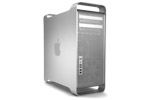
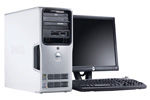
See Specifiactions below for system and/or OS compatibility information
The CalDigit RAID Card utilizes a dedicated, internal drive channel within your existing system. It instantly expands your present system giving you high availability access and secure storage for all your databases and large media files, with up to 16TB capacity. Our unique, cross-platform technology is compatible with MAC OS X, Windows and Linux workstations. All CalDigit products support a variety of software applications and have been validated by Matrox Video Group, Blackmagic Design and Media 100..
Room to Grow
The CalDigit RAID Card supports up to 16 drives, 4 internal and 12 external. This gives you up to 24 TB of capacity!
CalDigit's unique chip technology allows you utilize up to 4 of your existing, internal drives*. As your workloads increase it is easy to expand your storage capacity. The CalDigit RAID card can connect to up to 3 HDElements** for a total of 12 drives externally.
*Only on recommended hard drives
**The HDElement is the exclusive external storage solution for the CalDigit RAID Card.
Why Choose Hardware RAID?
While software RAID may seem like a viable option to hardware RAID, the advantages of having a hardware solution are many.
CalDigit's RAID Card is a 100% hardware disk controller that comes with its own, independent CPU. This uses less CPU cycles and power than a software solution and leaves your workstation's CPU free to do what it has been designed for - running your applications. Software RAIDs use your workstation's CPU. This takes away processing power from other applications and slows your whole system down. Hardware RAID gives you the ultimate in protection from OS corruption or crashes while a software application gives no protection at all. Software RAIDs are also generally more complicated to run and configure.
The CalDigit RAID Card is straightforward and simple to use and includes additional features for optimizing the performance of your system.
Engineered for Speed and Protection
The CalDigit RAID Card has been designed for both speed and protection. It comes with multi RAID level capabilities that can be configured to suit your project's requirements.
If high speed performance is your only concern set your RAID level to 0. At RAID 1 your data is mirrored on to two drives. This gives you the best protection in a multi-user system. The read performance is improved since either disk can be read at the same time, while the write function remains the same as single disk storage.
With a sustained speed of up to 500 MB/sec. at RAID 5, the CalDigit RAID Card is hard to beat. RAID 5 is best suited for multi-user systems in which performance is not so critical and that do few write operations. At RAID 6 your system can sustain two drive failures without data loss, giving you dual parity protection. This offers extremely high fault and drive-failure tolerance and rapid speed availability. And if that isn’t enough, the CalDigit RAID Card can also be set to levels 50, 60 and JBOD.
Responsive and Adaptable
As a digital professional your workstation needs to be able to adapt to, and support, all your workload needs.
Due to the RAID Card's compatibility with Mac, Windows and Linux workstations and its expandability up to 16 drives it offers a remarkable flexibility. As your workloads grow and your storage* requirements increase the RAID Card allows you to add up additional storage units as they are needed. This gives you "pay-as-you-grow" scalability as your business expands.
*For adding external storage to the CalDigit RAID Card, please go to
http://www.caldigit.com/HDElement/ for more information. The HDElement is a compact
4-bay storage enclosure that fully utilizes the CalDigit RAID Card's hardware protection
and performance for all your valuable data.
Easy to Use and Accessible
At CalDigit we know that most computer users are not IT engineers. That is why we have designed our unique RAID Shield Client GUI, with the customer in mind.
You no longer need to be baffled by commands and window layouts that are hard to understand. Managing your drives, running regular performance checks and monitoring your system have never been more straightforward.
The CalDigit RAID Card uses anenvironment monitorprocessor to run all aspects of the system. Our Raid Shield allows you to check your hard drive, add or remove the controller, monitor the controller cache, maintain enclosure conditions, fan, temperature and power supply.
You can configure and manage the RAID arrays and fix problems with a simple click of the mouse. In the event of any errors, alerts or changes to the RAID array an e-mail notification is sent to you immediately.
Built-In Intel XScale Core Processor
The CalDigit RAID Card comes with a built-in Intel XScale Core Processor. It optimizes low power consumption, maximizes performance, accelerates data processing and adds protection to storage.
Bootable
CalDigit RAID Card is bootable.
You have the ability to start up from CalDigit RAID Card if you have installed OS such as Mac OS, Windows, or Linux. Starting up from CalDigit RAID Card enables you to troubleshoot your system start up disk when errors occured.
Starting up from your RAID Volume can also give you mobility when you need to take your footage and configured system with you in various locations.