


 1-800-275-4576

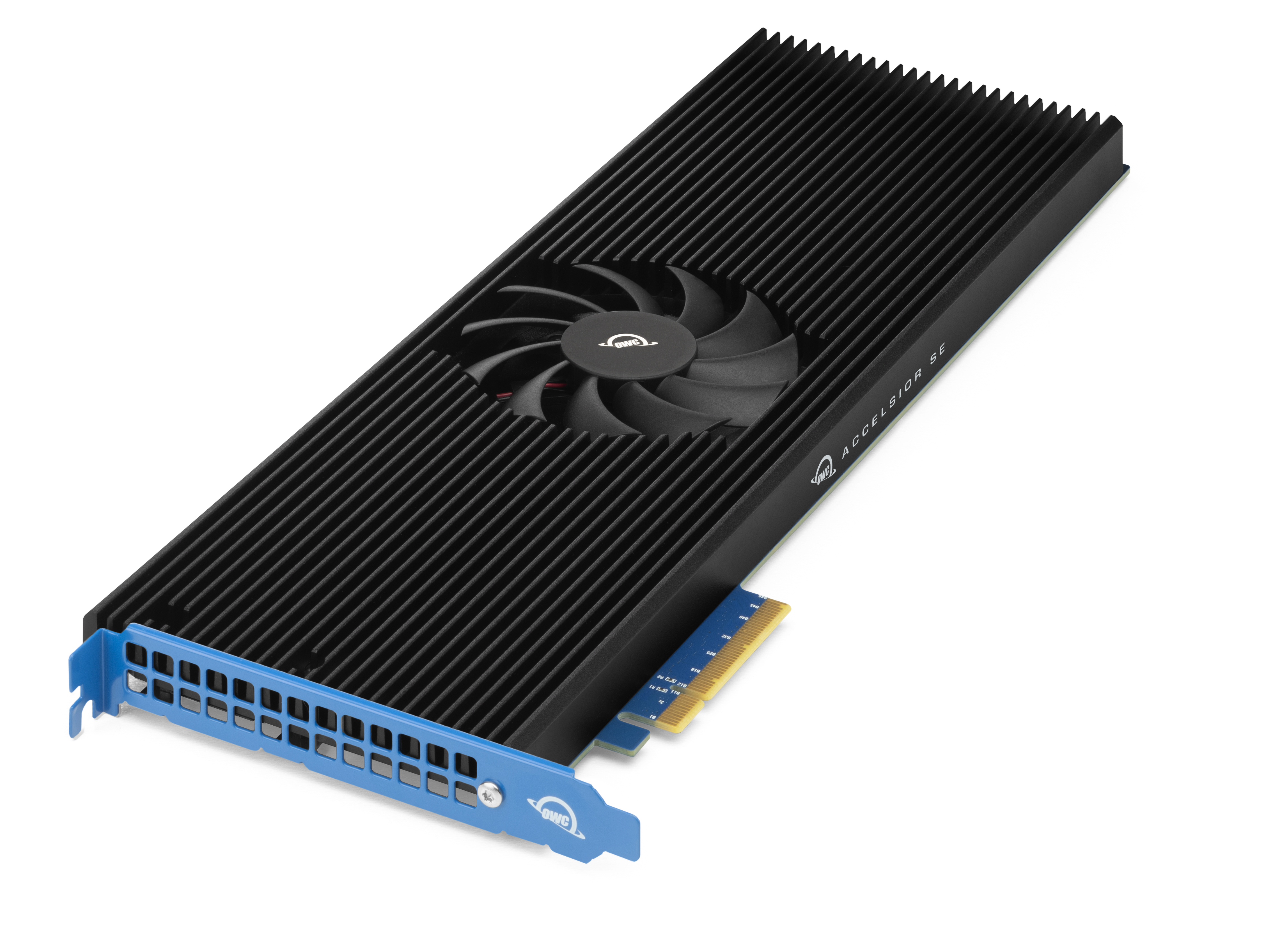
OWC Accelsior SE
Support Manual
Introduction
1.1 System Requirements
Operating System:
- Mac: macOS 10.13.6 or later
- PC: Windows 10 or later | Windows Server 2016 or later
Hardware:
- Mac or PC compatible with Node Titan or a third party PCIe chassis that supports full height, full length, single width cards
- Mac Pro (2019) | Mac Pro (2023)
- PC that supports the following:
- Form Factor: full height, full length, single width
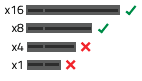
- Physical: x8 | x16
- Lanes: x16 strongly recommended
- PCIe 3.0 or later strongly recommended
- NOTE: Proper system cooling should be considered when installing the OWC Accelsior SE into a PC. This can be achieved through the addition of front or side PC case fans or by leaving unused PCIe slots between installed devices.
1.2 Package Contents
- (1) OWC Accelsior SE
- (1) 3 Years of SoftRAID Premium Access (with select solutions)
- License located on bottom of device
1.3 Overview
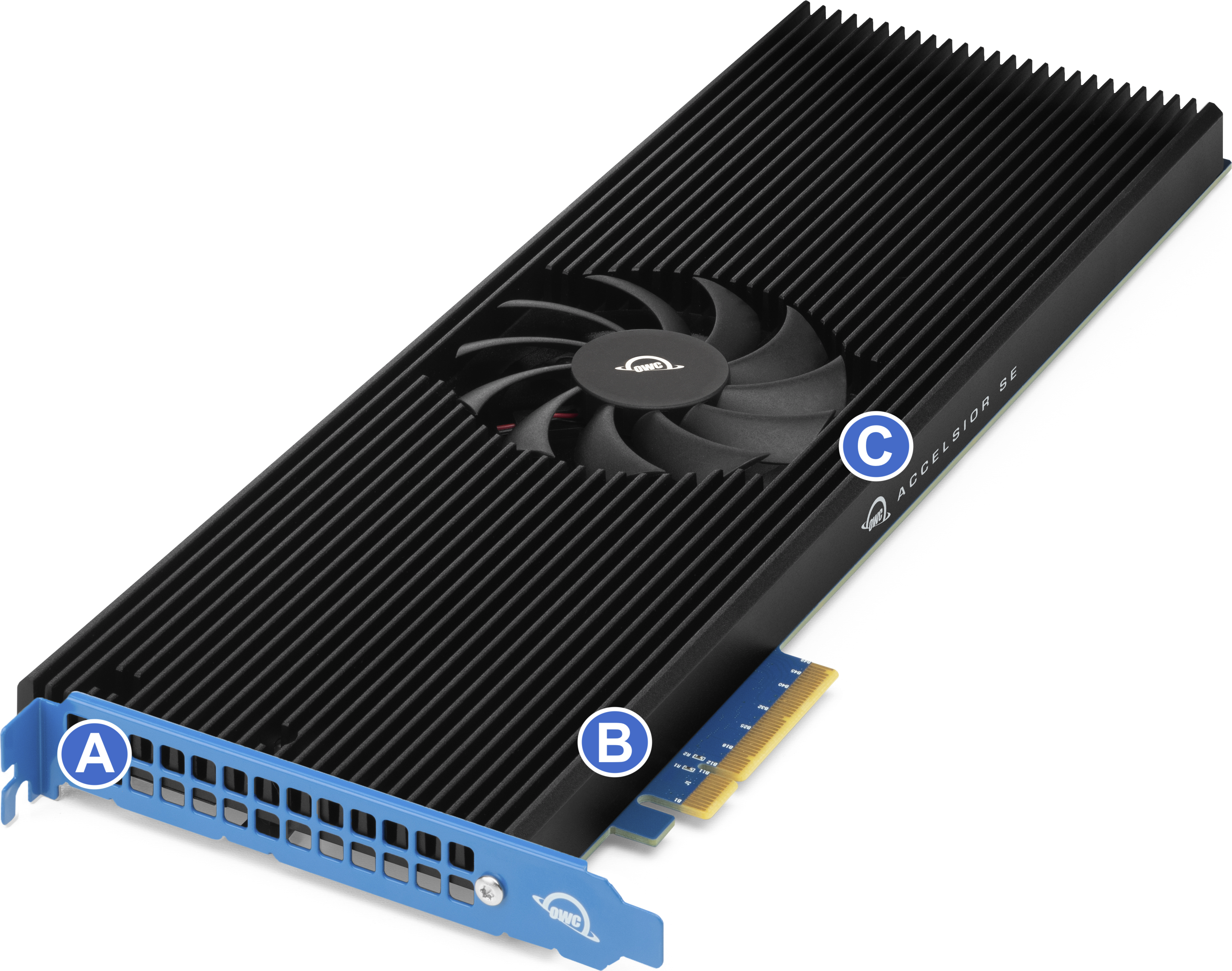
A. PCIe Bracket - Screws into the system chassis to reinforce card stability
B. PCIe Connector - Align with a compatible PCIe slot on the host system or enclosure
C. Cooling Fan - Helps maintain the operating temperature
Getting Started
2.1 Device Setup
- The OWC Accelsior SE is available assembled with (9) NVMe M.2 SSDs configured as an OWC SoftRAID RAID 0.
1. Disconnect all power and powered devices from your host or PCIe enclosure. Open the host or enclosure so the compatible PCIe slot(s) are visible and accessible.
- NOTE: The OWC Accelsior SE will only physically fit into a x8 | x16 PCIe slot. Consult your host or enclosure manual to determine the PCIe slot location and physical size.
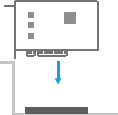
2. Align the PCIe connector of the OWC Accelsior SE with the compatible slot on your host. Carefully seat the drive into the slot. If there is resistance, do not force the drive into the slot. Remove the drive, re-align the connector, and try again.
3. Once the drive is fully seated affix the included screw to the bracket.

4. The OWC Accelsior SE is configured as an OWC SoftRAID RAID 0. Downloading and installing the latest version of SoftRAID is recommended to experience the best performance.
- NOTE: OWC Accelsior SE devices come bundled with "3 Years of SoftRAID Premium Access". Please visit OWC SoftRAID Product Details for more information regarding SoftRAID and the bundled Premium Access.
- NOTE: The OWC SoftRAID license is located on the back of the OWC Accelsior SE.
Mac OWC SoftRAID Setup
- Download OWC SoftRAID for Mac.
- Please review and follow the steps outlined in OWC SoftRAID Installation for Mac.
Windows OWC SoftRAID Setup
- If you are using the OWC Accelsior SE with the Windows operating system, the pre-installed drives need to be reconfigured before they can be used. The following options will allow the Mac formatted OWC Accelsior SE to work as a Windows formatted device.
- Download OWC SoftRAID for Windows
- Please review and follow the steps outlined in OWC SoftRAID Installation for Windows.
- Please consult the support article "Mac to Windows – SoftRAID Volume Conversation" for instructions to convert the Mac formatted OWC SoftRAID RAID 0 to a Windows formatted device through OWC SoftRAID.
- The Mac formatted OWC SoftRAID RAID 0 OWC Accelsior SE can be used in Windows through the purchase and installation of OWC MacDrive. OWC MacDrive allows access to software RAID Mac-formatted drives in Windows without performing a conversion process. Please visit OWC MacDrive Product Details or OWC MacDrive Support for more information.
2.2 Device Assembly
- This section describes the process of installing drives into the OWC Accelsior SE if purchased as a bare enclosure.
- For maximum performance install (9) identical NVMe M.2 SSDs.
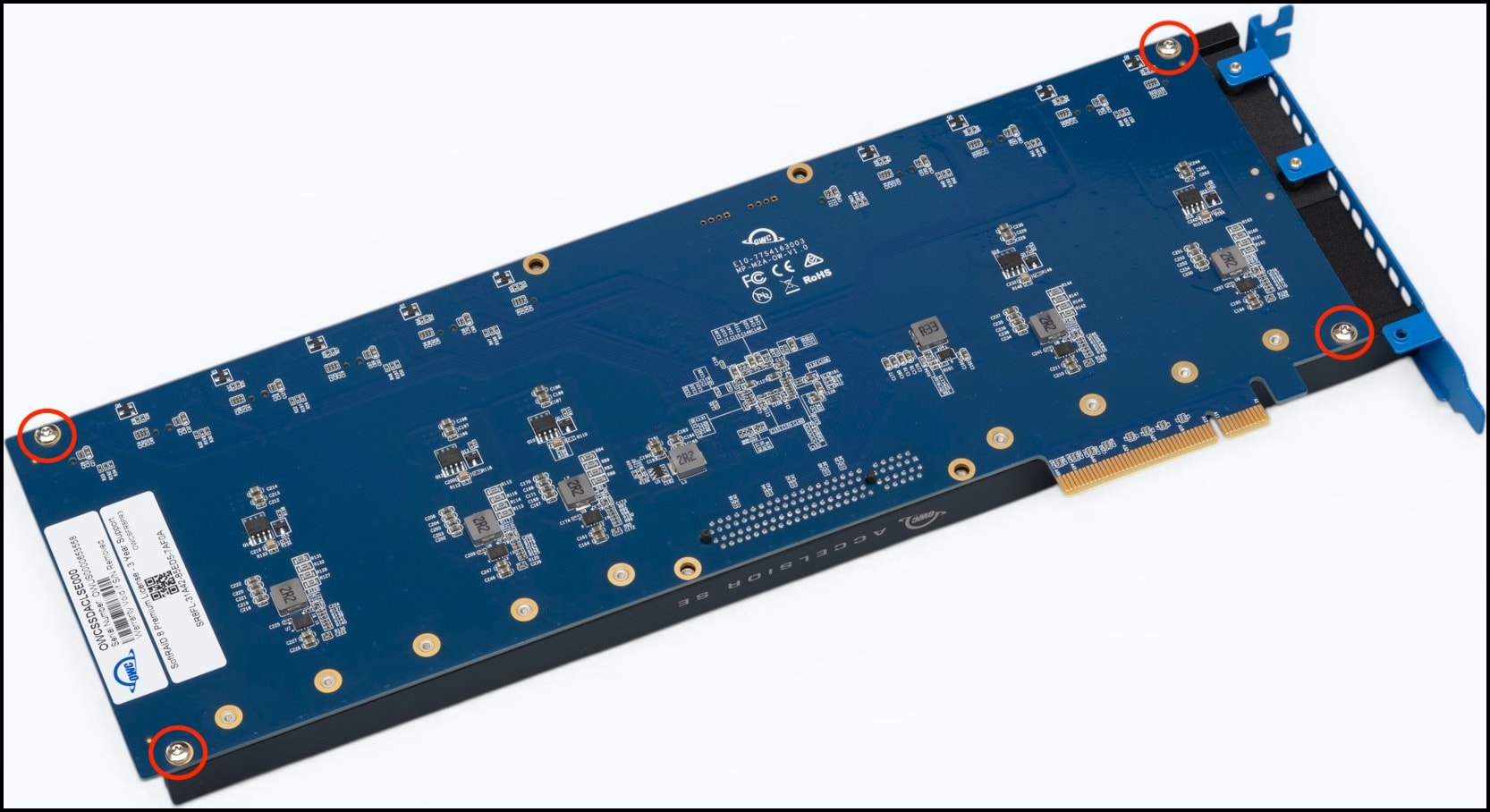
1. Place the OWC Accelsior SE on a flat static free surface with the bottom facing upwards. Remove the four screws (highlighted) with a T8 screwdriver (included) to loosen the connection between the black heat sink and drive board.
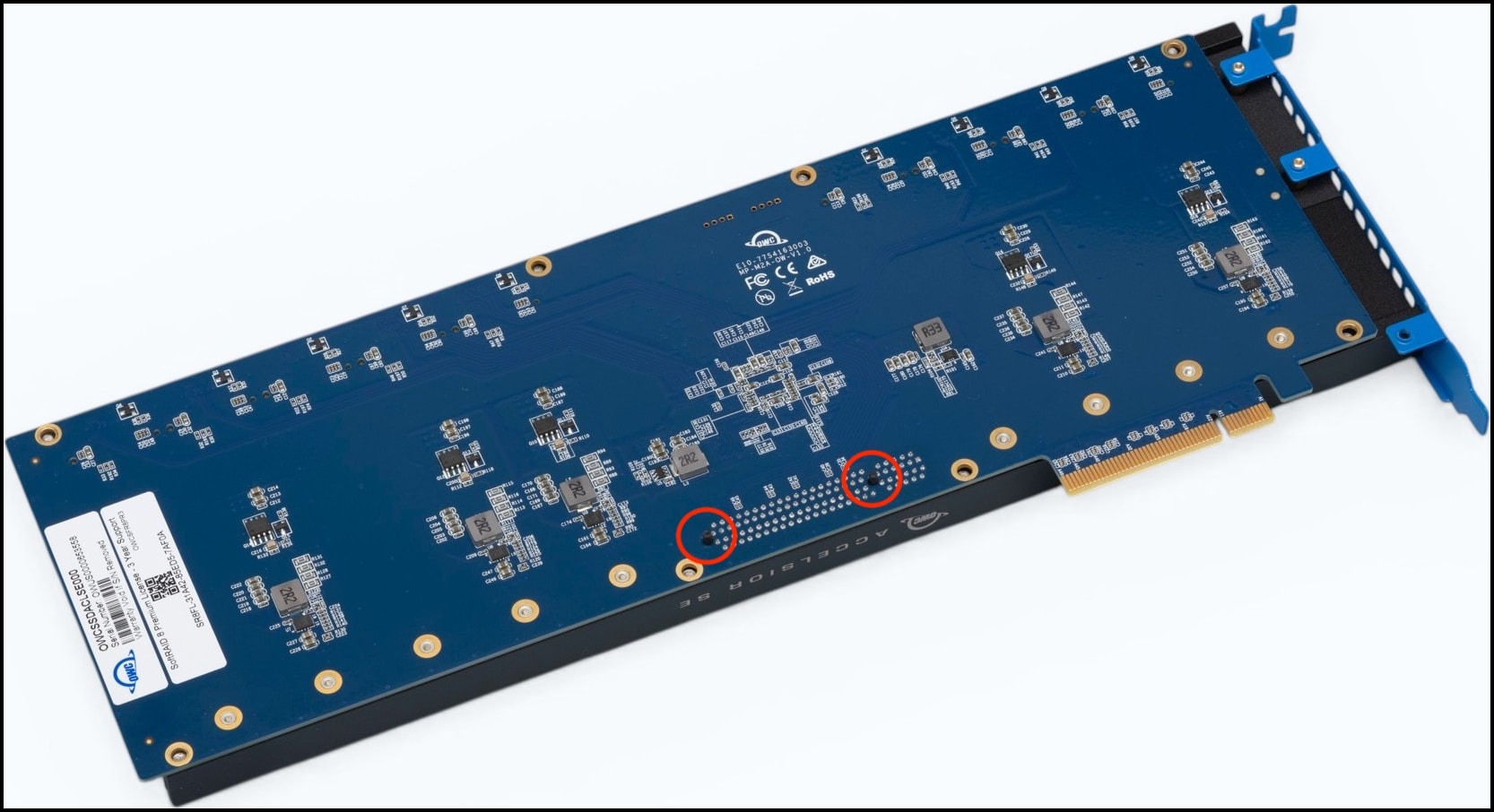
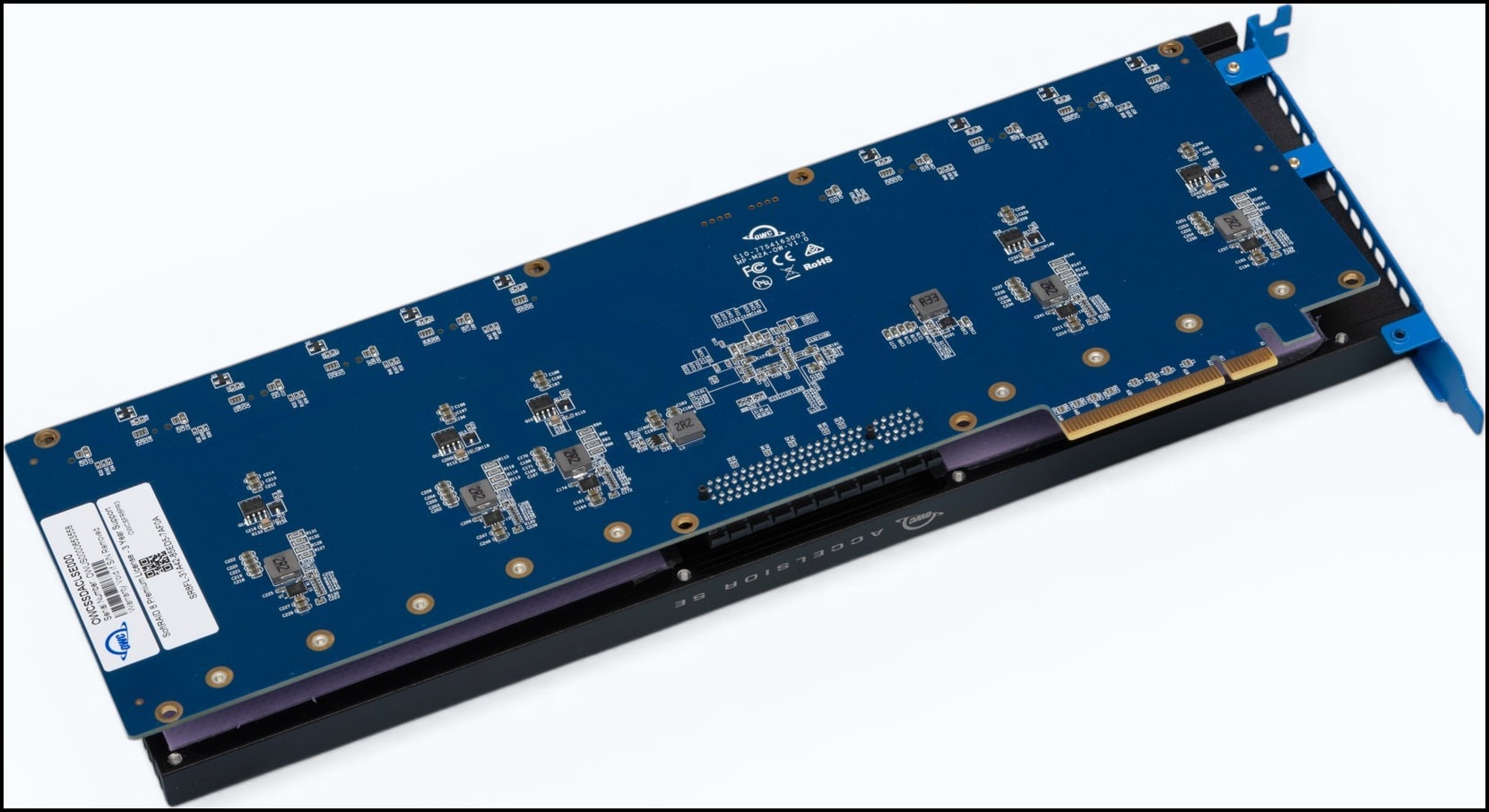
2. Carefully separate the black heat sink and drive board.
- If more resistance is experienced than expected, extra force should not be applied. Instead, carefully separate the pieces like opening a book from the side of the card with the black posts (highlighted).
3. Turn the drive board over to expose the NVMe M.2 SSD slots.
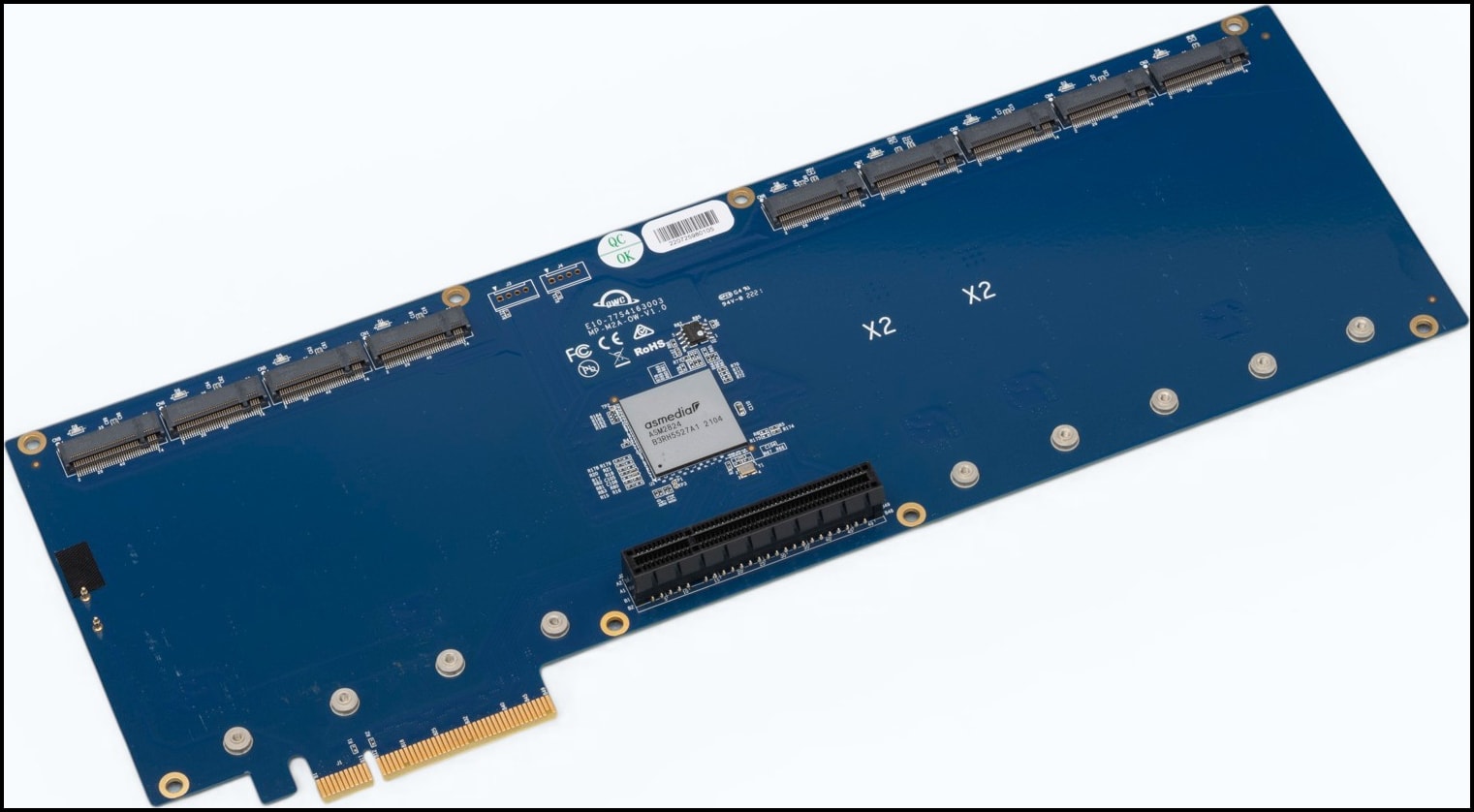
4. Thermal pads need to be installed onto the drive board before installing NVMe M.2 SSDs. The circuit board layout of the NVMe M.2 SSD will determine the location of the thermal pad placement. The thermal pad placement allows for better temperature control and even pressure when the black heat sink is attached to the drive board.
- The thermal pad should be placed under the lowest point of the drive. The following example highlights the recommended location to place the thermal pad for an OWC Aura Pro IV NVMe M.2 SSD.
- NOTE: The thermal pads have a protective film that should be removed before adhering to the drive board.
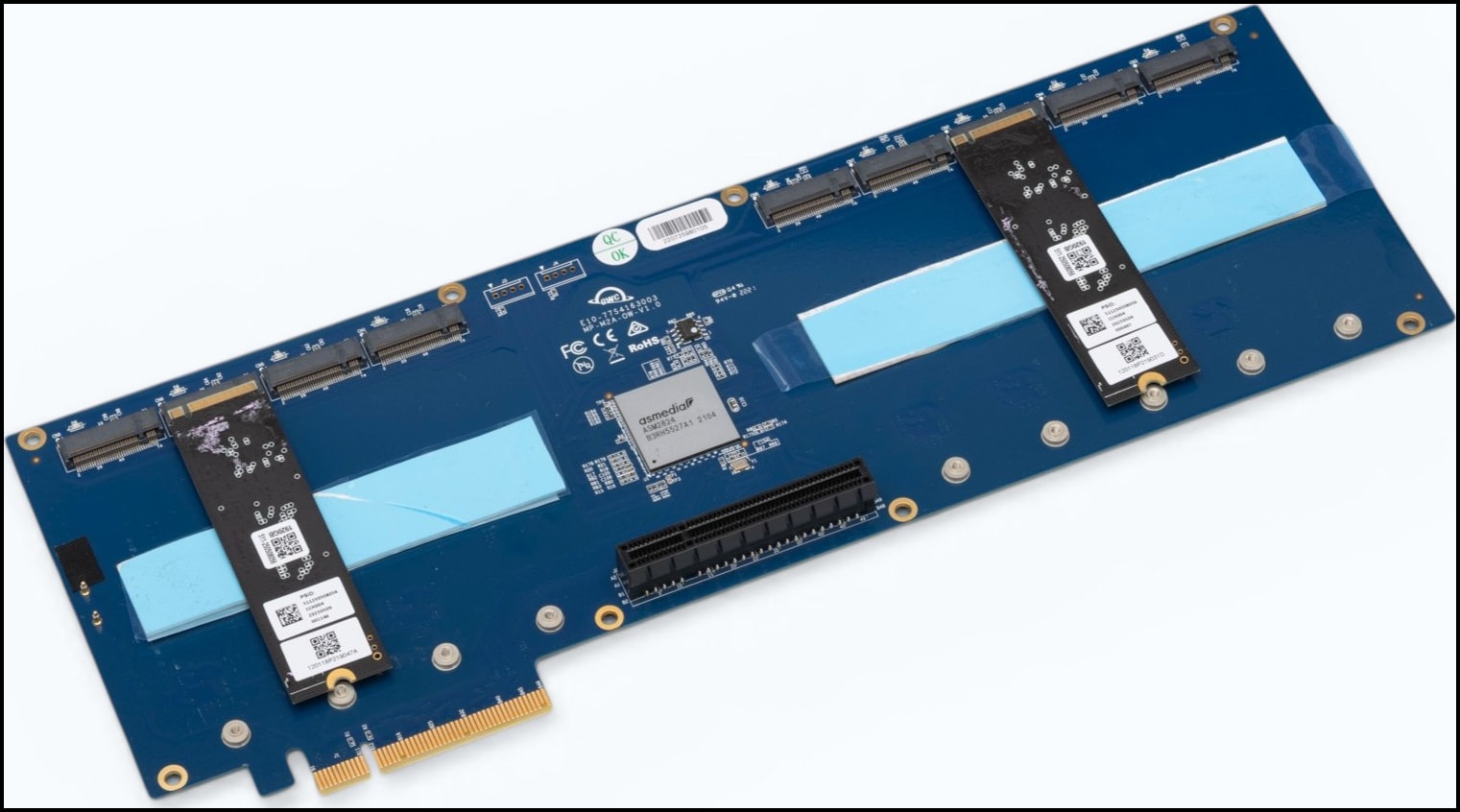
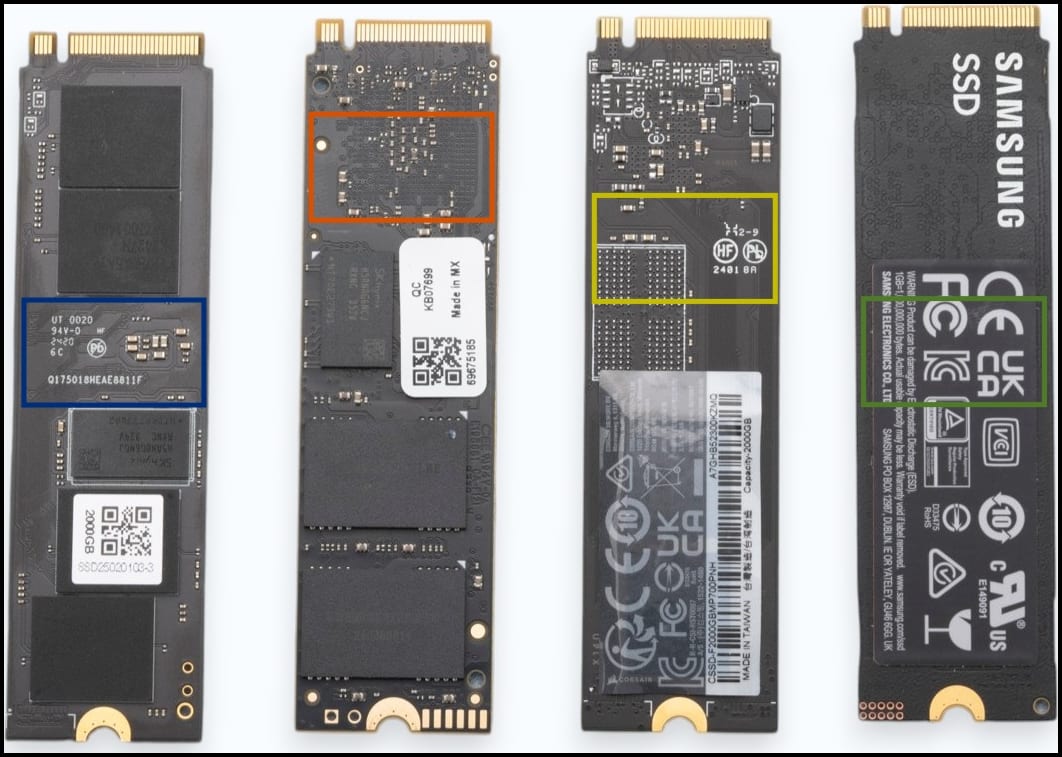
- The following are additional recommendations for different NVMe M.2 SSDs based on circuit board layout. The arrows in the second image show the recommended placement line for the thermal pad.
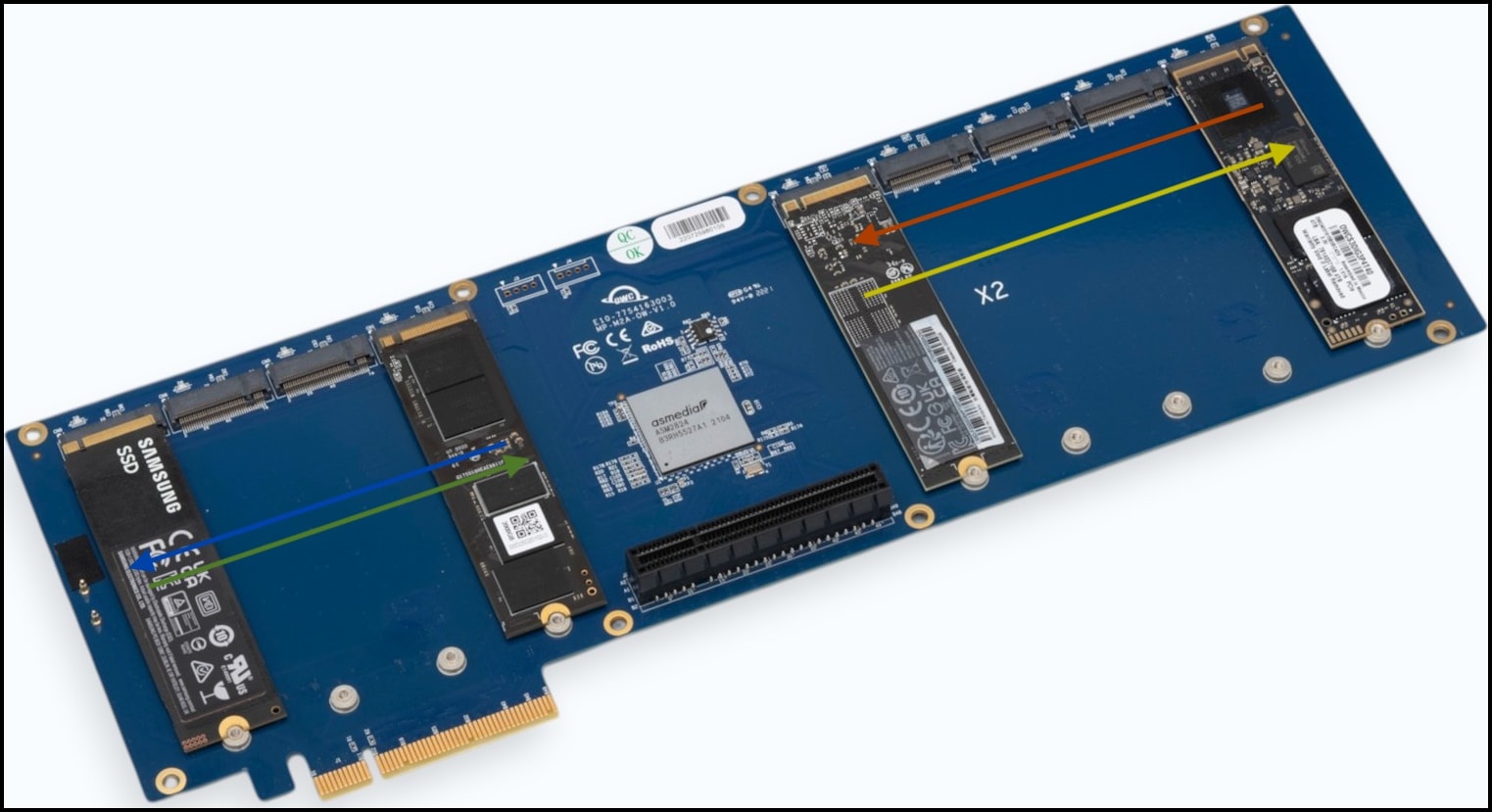
5. Carefully align the NVMe M.2 SSD at a slight angle into the drive board connection and slide it forwards until fully connected. The drive will rest at a slight angle when folly connected.
- NOTE: Ensure the protective film covering the thermal pads have been removed.
- NOTE: Please do not force the drive into the board connection. Minimal force is required. Remove and realign the drive If resistance is felt.
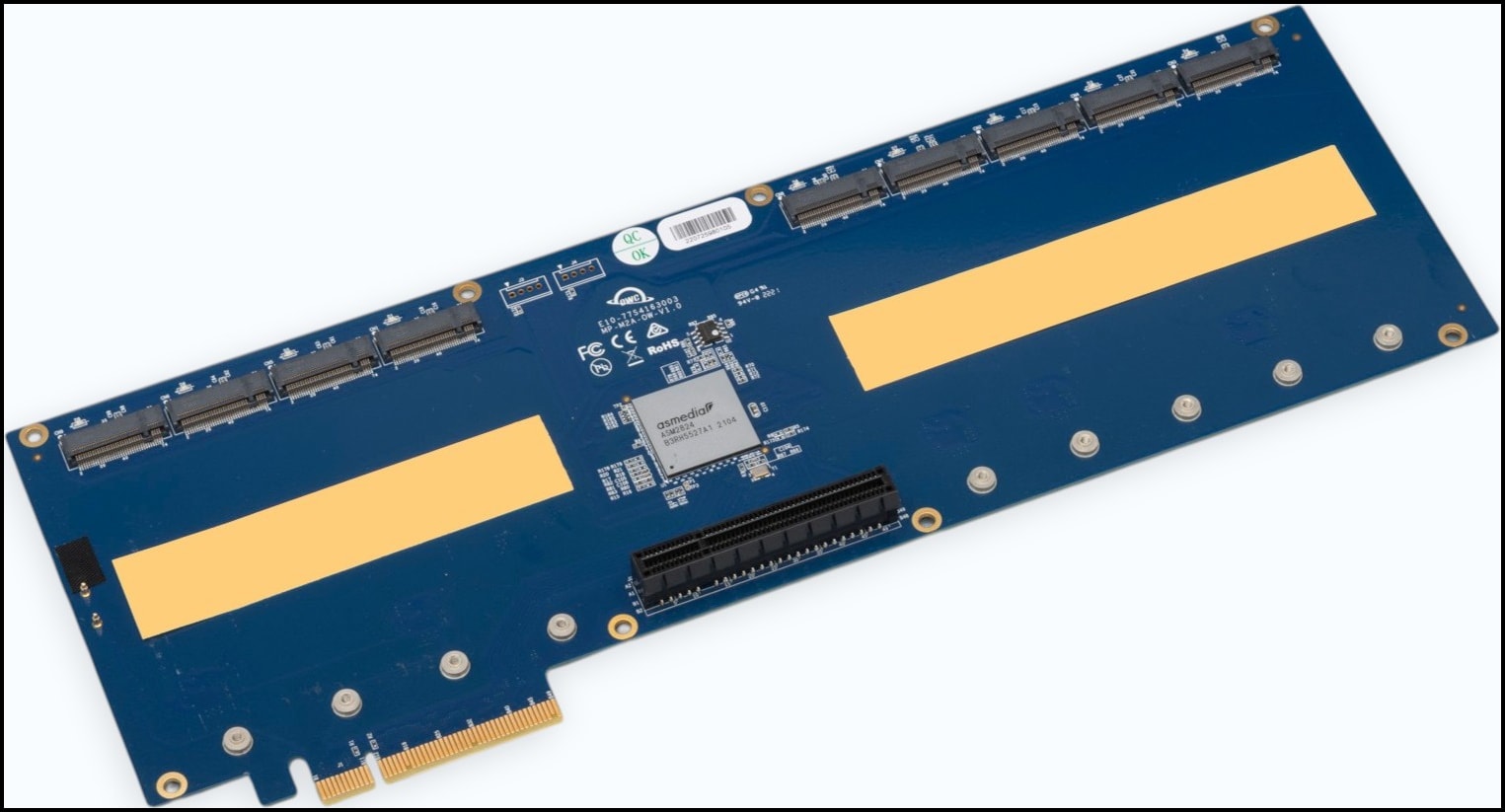
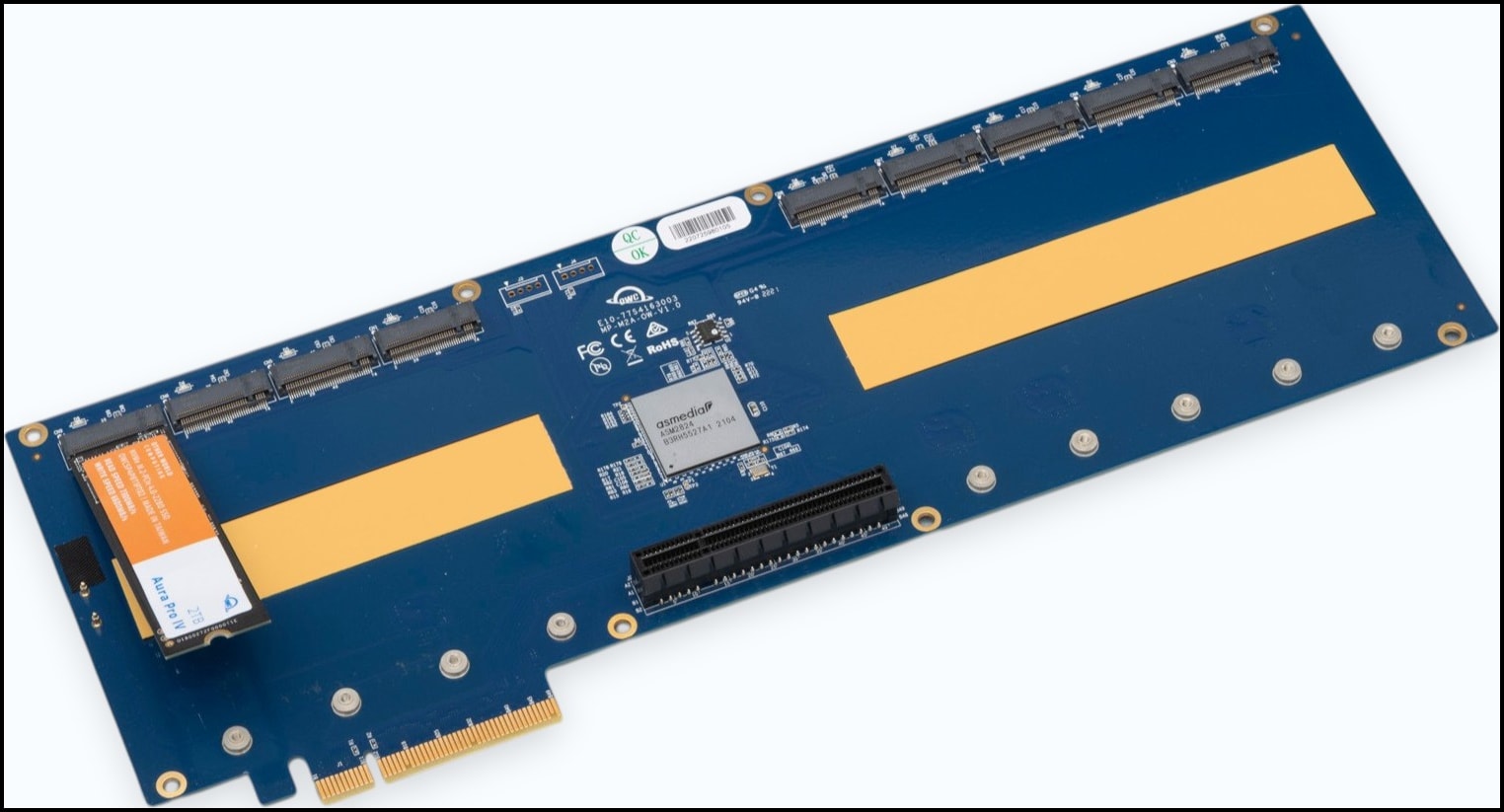
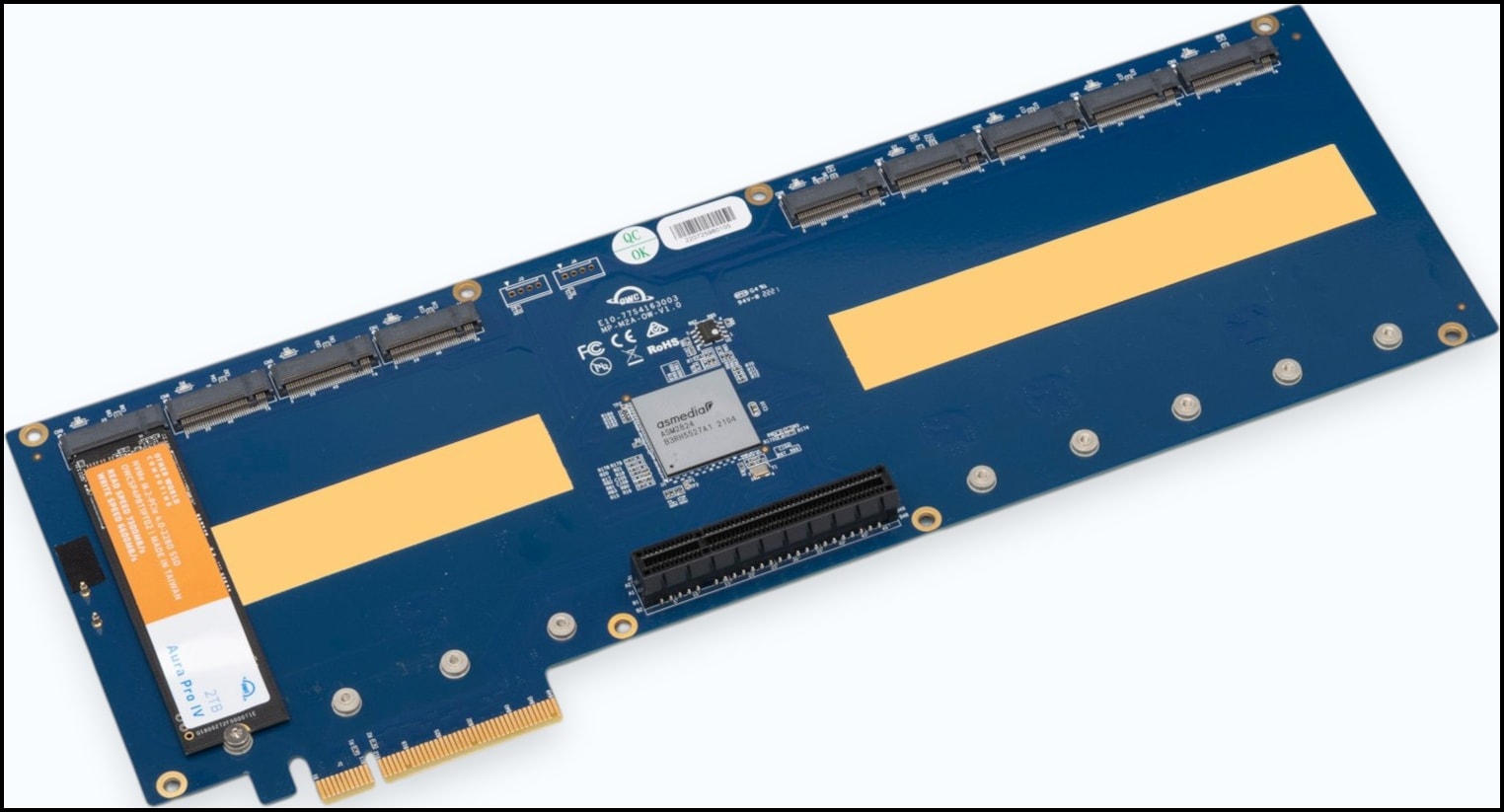
6. Press the drive down onto the board and secure using the included drive screws with a PH01 screwdriver (included).
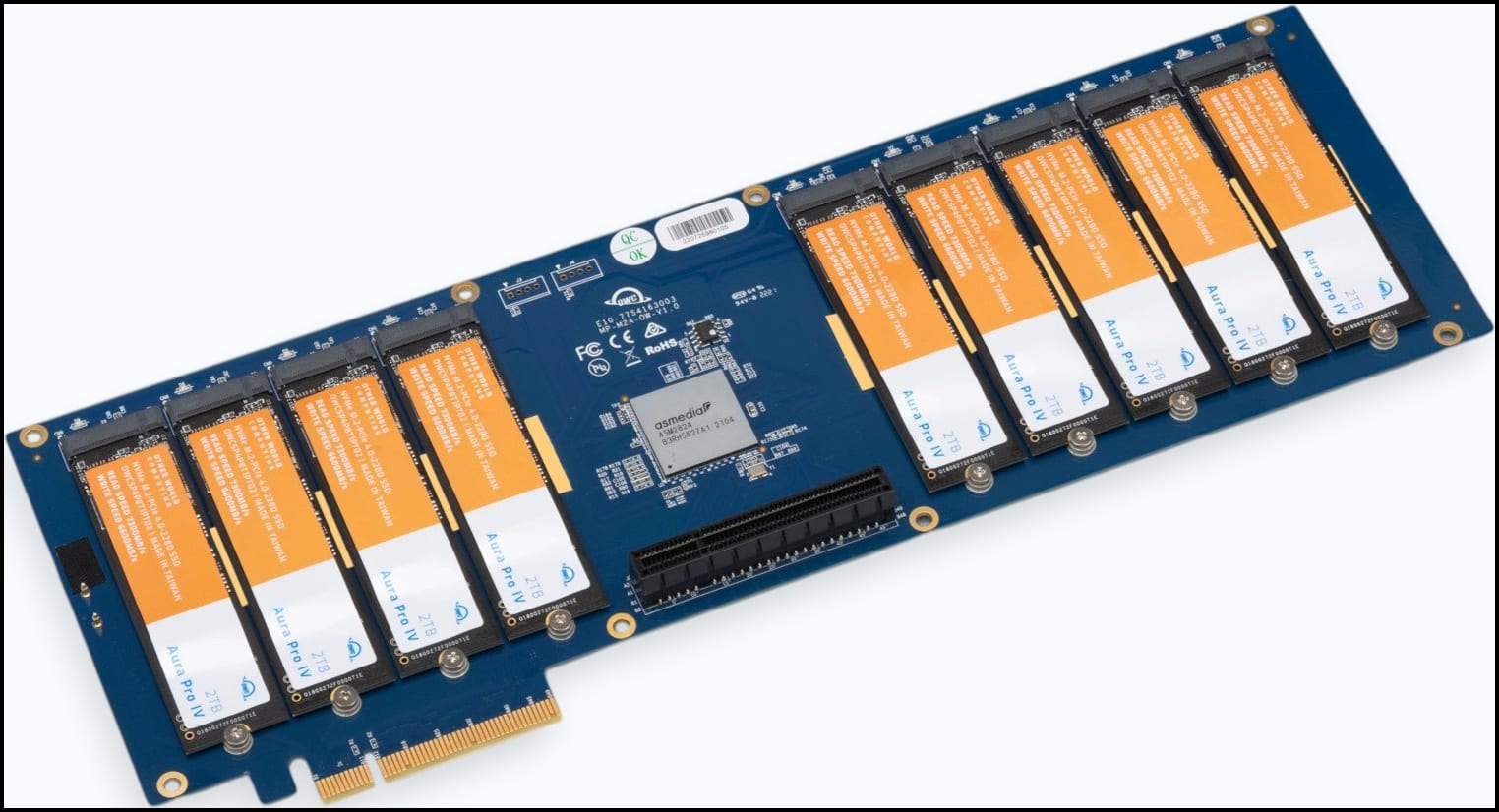
7. Repeat this process (8) additional times resulting in (9) installed NVMe M.2 SSDs.
8. Removed the protective film from the thermal pads on the black heat sink.
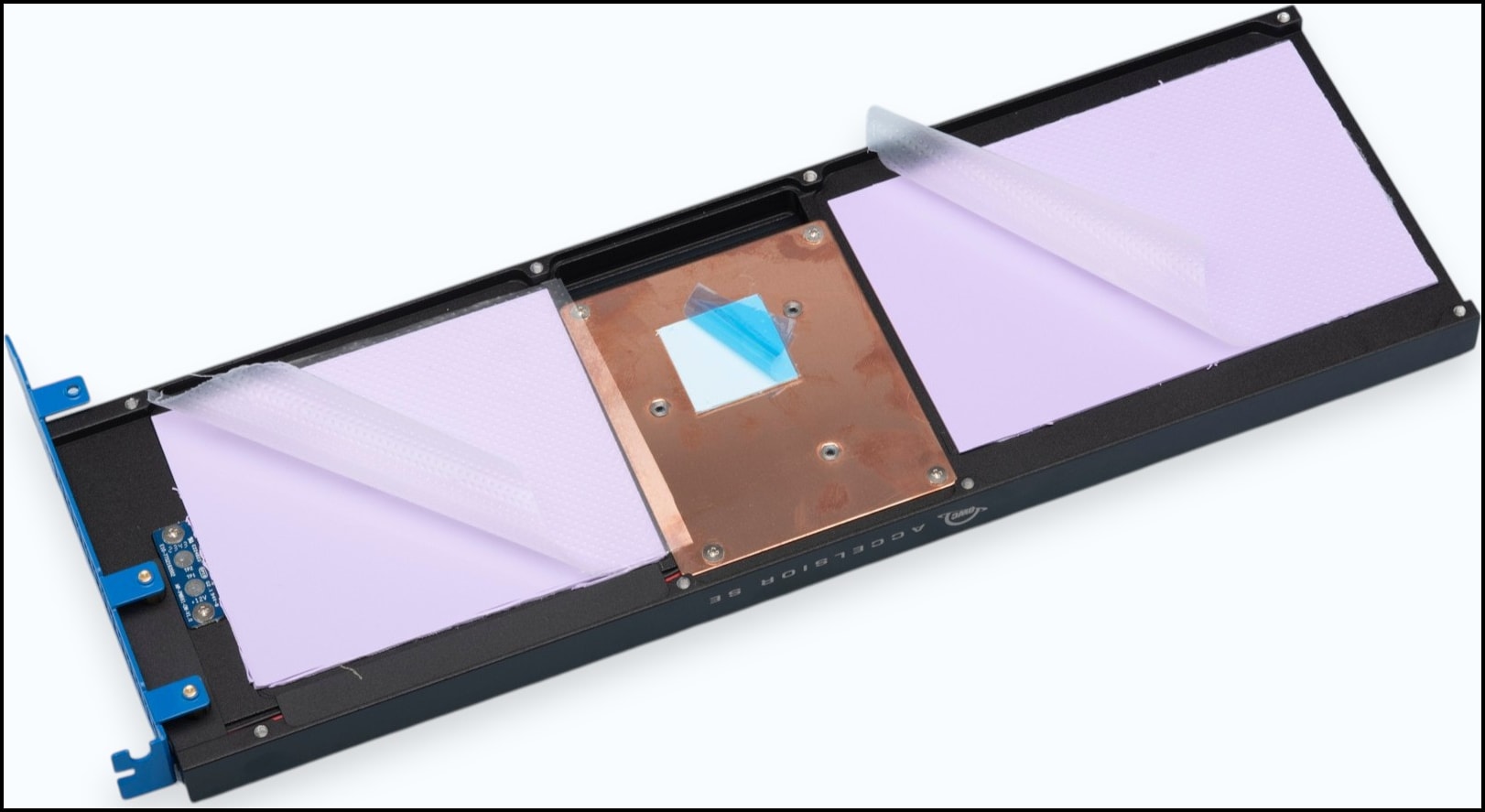
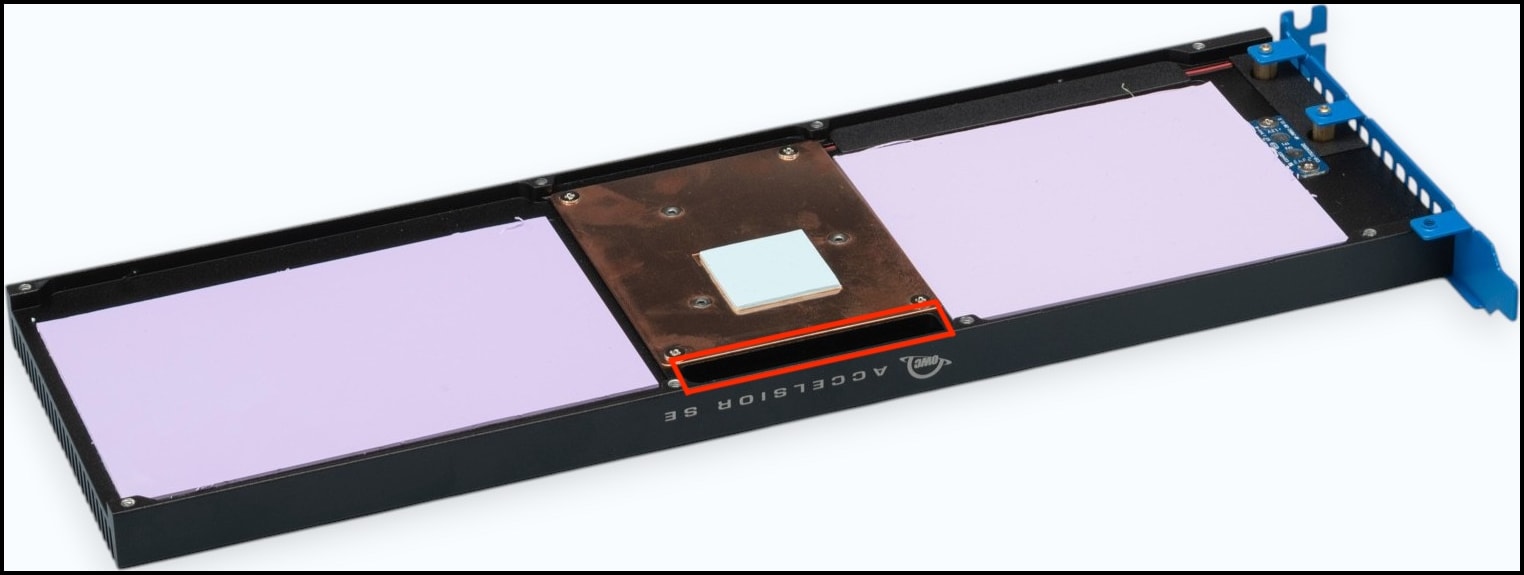
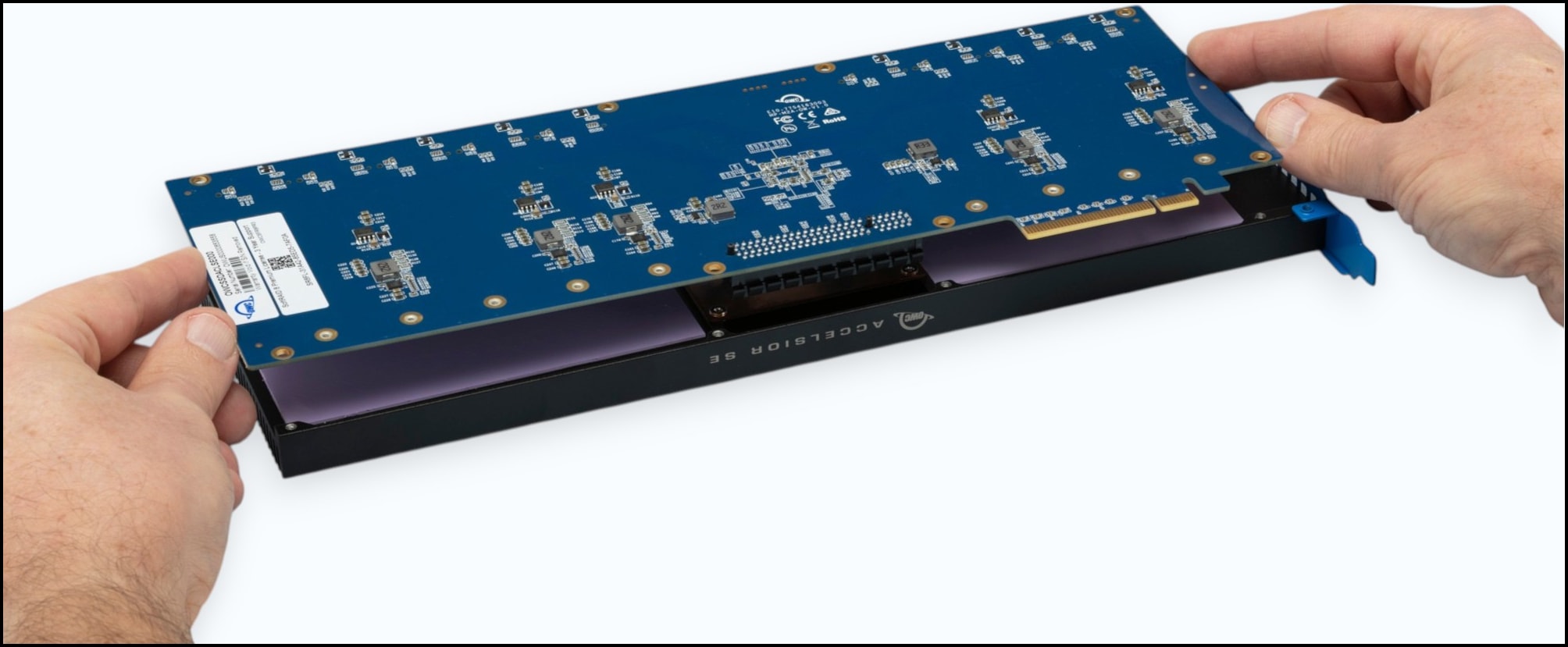
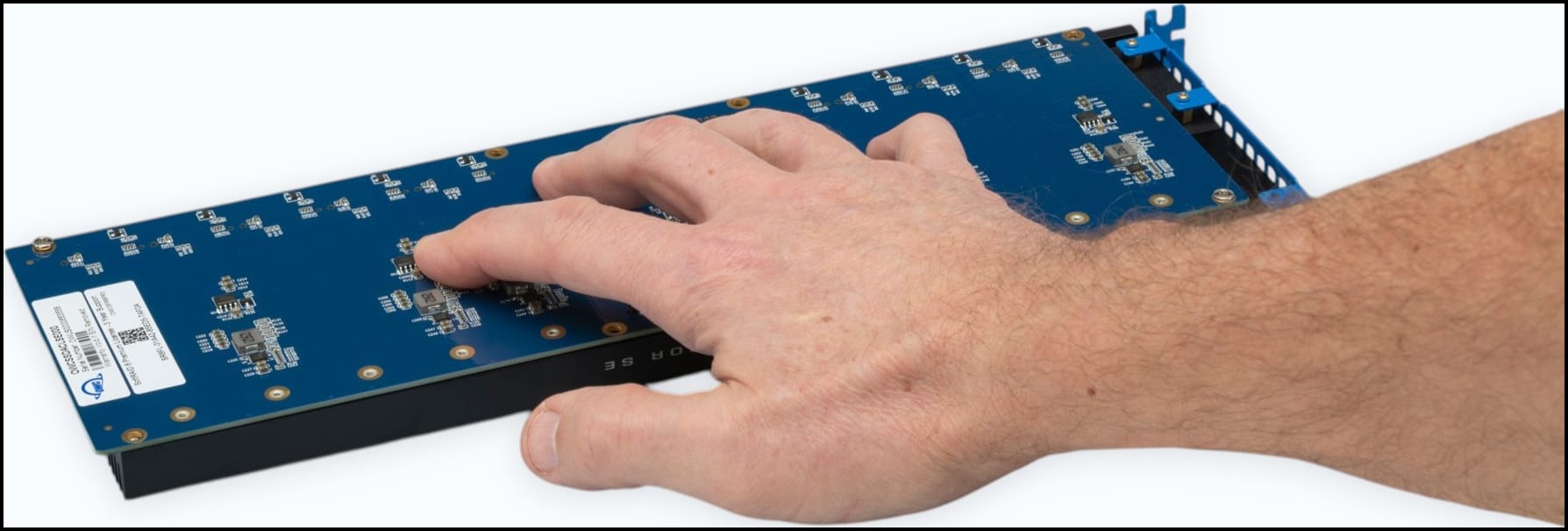
9. Align the PCIe bridge bracket of the drive card with the open notch of the black heat sink (highlighted). Apply light pressure to secure the connection between the drives and thermal pads.
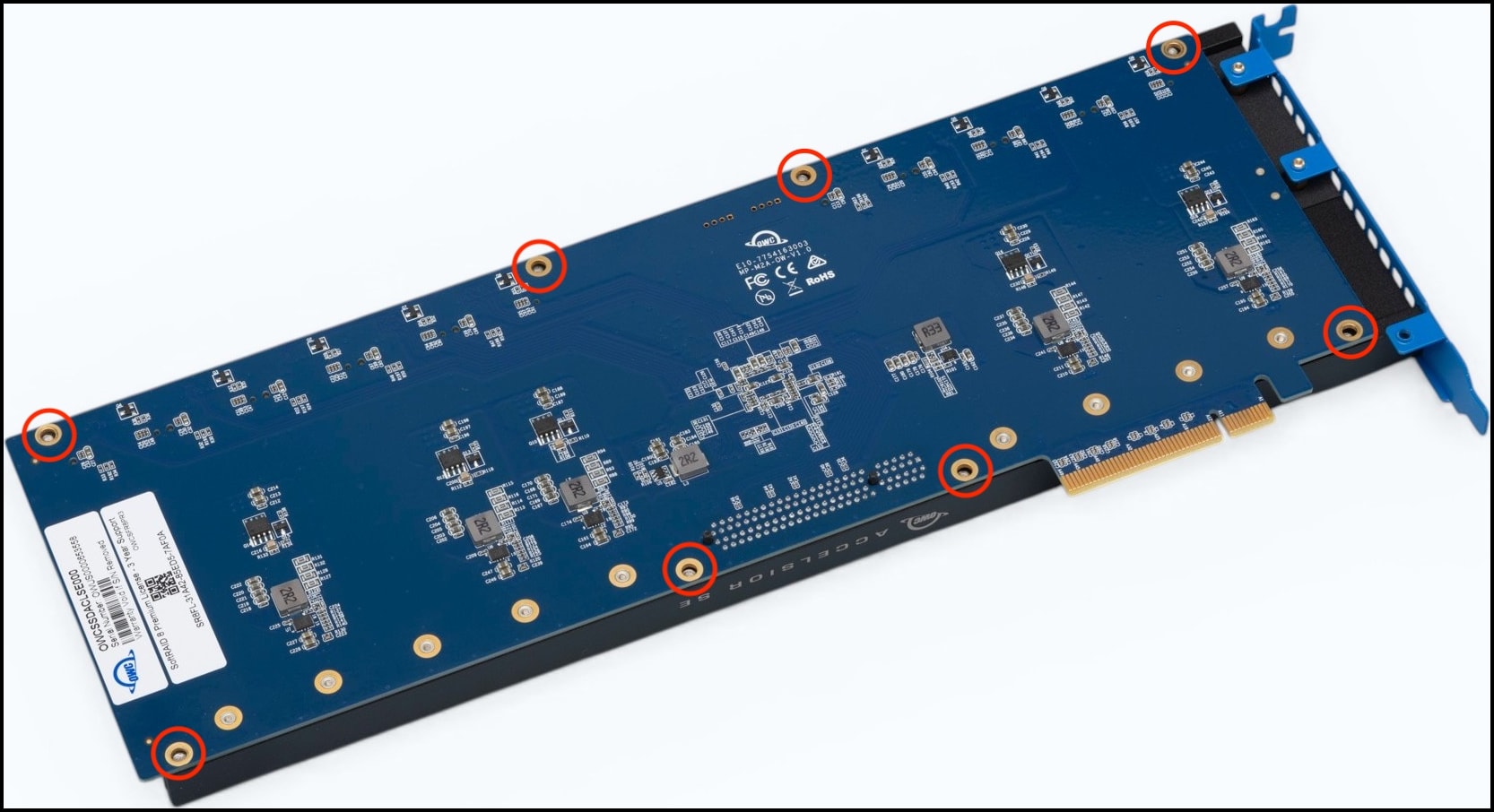
10. Secure the black heat sink to the drive board using (2) of the T8 screws removed from earlier and the additional T8 screws (included) in the highlighted locations.
11. Align the PCIe connector of the OWC Accelsior SE with the compatible slot on your host as highlighted. Carefully seat the drive into the slot. If there is resistance, do not force the drive into the slot. Remove the drive, re-align the connector, and try again.
- NOTE: Obtain the OWC SoftRAID serial number from the bottom of the card before installing into a host.
12. Once the drive is fully seated affix the included screw to the bracket.
13. The installed drives are ready to be formatted. OWC recommends creating a RAID volume for best performance.
- Section 2.3 “RAID Configuration Options” is the next section that will provide instructions on how to format and configure the drives in the OWC Accelsior SE.
2.3 RAID Configuration Options
OWC SoftRAID Configuration
- Select OWC Accelsior SE devices come bundled with "3 Years of SoftRAID Premium Access". Please visit OWC SoftRAID Product Details for more information regarding SoftRAID and the bundled Premium Access.
- NOTE: Downloading and installing the latest version of OWC SoftRAID is recommended to experience the best performance from the OWC Accelsior SE.
- SoftRAID will assist with formatting the installed drives and setting up a RAID volume.
- NOTE: The OWC SoftRAID license is located on the bottom of the OWC Accelsior SE.
Mac OWC SoftRAID Setup
- Download OWC SoftRAID for Mac.
- Please review and follow the steps outlined in OWC SoftRAID Installation for Mac.
- Please review and follow the instructions outlined in Creating a macOS OWC SoftRAID Volume.
Windows OWC SoftRAID Setup
- Download OWC SoftRAID for Windows
- Please review and follow the steps outlined in OWC SoftRAID Installation for Windows.
- Please review and follow the instructions outlined in Creating a Windows OWC SoftRAID Volume.
Mac Software RAID Setup
Open the “Disk Utility” application on your Mac.
2. Choose “File” and select “RAID Assistant”.
3. Select a set type:
- Striped (RAID 0) set: A striped RAID set can speed up access to your data. You can’t create a RAID set on your startup disk; you must first start up your computer from another disk.
- Mirrored (RAID 1) set: Protect your data against hardware failure with a mirrored RAID set. When you create a mirrored RAID set, your data is written to multiple disks so the information is stored redundantly. You can’t create a RAID set on your startup disk; you must first start up your computer from another disk.
- Concatenated (JBOD) set: Increase storage space with a concatenated disk set. If you need one large disk, but you have several smaller disks, you can create a concatenated disk set to use as one large disk.
4. Select the checkboxes of the disks you want to include in the set.
5. For each disk, click the pop-up menu in the Role column and choose “RAID slice” or “Spare” to designate the disk as a standard member or spare in the set, then click "Next".
6. Enter a name for the RAID set in the RAID Name field.
7. Click the Format pop-up menu, then choose a volume format that you want for all the disks in the set. (See File system formats available in Disk Utility.)
8. Click the “Chunk size” pop-up menu, then choose a disk chunk size that you want used for all the disks.
- When you create a striped set, chunks of data from the same file are distributed across the drives. Ideally, you want data distributed across drives evenly and at an optimum size so that it can be efficiently accessed.
- If you want high data throughput from your set, choose a smaller chunk size so that data is spread across the drives and one drive can be accessing data while another is seeking the next chunk.
- With mirrored disk sets, choose a chunk size that matches the data you’re accessing. For example, when working with video files, your Mac is accessing large chunks of data, whereas when using a database of many small records, your disks may be accessing smaller chunks of information.
9. If you are creating a mirrored RAID set, select the “Automatically rebuild” checkbox to allow the set to be automatically rebuilt when member disks are reconnected
10. Click "Create" and then click "Done".
Device Management
3.1 OWC Disk Performance
Windows users connecting the OWC Accelsior SE through an external PCIe enclosure may need to change the default Disk Removal Policy.
- As of Windows 10 v. 1809 the default Disk Removal Policy is ‘Quick removal’ instead of ‘Better performance’.
- NOTE: OWC storage solutions that are experiencing slow read/write speeds should consider checking and changing the Windows disk removal policy. Changing from "Quick removal" to "Better performance" can increase disk performance. OWC offers the application OWC Disk Performance to help change the Disk Removal Policy. Changing from "Quick removal" to "Better performance" can also be changed through OWC SoftRAID or manually through the operating system.
- Please review the support article Storage Solutions: OWC Disk Performance for additional details.
3.2 Manually Unmounting Volumes
To ensure no data is lost during normal use, always eject or unmount the corresponding volume(s) from the operating system before powering off and disconnecting the device. Unmounting options are provided below.
macOS
- Drag the icon for the device you wish to unmount to the trash can; OR
- Right-click the device icon on the desktop, then click “Eject”; OR
- Highlight the device on your Desktop and press Command-E.
Windows
- Windows 10 build 1809 (October 2018) or later:
- Eject the drive by clicking the ‘Show hidden items’ menu in the Taskbar, then clicking ‘Safely Remove Hardware and Eject Media’, and last select the ‘Eject’ option for this volume.
- Windows 10 build 1803 and earlier:
- Go to the System Tray (located in the lower right corner of your screen). Click on the “Eject” icon (a small green arrow over a hardware image).
- A message will appear, detailing the devices that the “Eject” icon controls, i.e., “Safely remove...” Click on this prompt.
- You will then see a message that says, “Safe to Remove Hardware.” It is now safe to disconnect the device from the computer.
3.3 Usage Notes
- OWC SoftRAID works with macOS 10.14 or later and Windows 10 or later. M1 Macs require macOS 11.3 or later. SoftRAID is licensed per computer.
- The OWC Accelsior SE has a ASM2824 PCIe switch. This switch offers 8x upstream lanes allocated to the PCIe connector. 16x downstream lanes are also available and allocated as follows:
- 1x lane each to (7) SSDs.
- 2x lane each to (2) SSDs.
- The Accelsior SE, when used with Windows, doesn’t have a driver that displays the device name. Windows lists the device as a Mass Storage Controller due to the absent driver. Performance of the Accelsior SE in Windows is NOT affected by this device error.
- Before installing this product in a host device, write down the OWC SoftRAID serial number that is listed on the bottom of the OWC Accelsior SE before installation into a host. The OWC SoftRAID serial number is required for installation and operation of OWC SoftRAID.
Support Resources
4.1 Troubleshooting
- Windows users experiencing slow read/write speeds should consider checking and changing the Windows disk removal policy. Please review the support article Storage Solutions: OWC Disk Performance for additional details.
- We are very sorry If issues continue to occur. Please know that OWC support is here to help. Contact information for our support can be found in section 4.4 "Contacting Support". Please have your serial number ready which is located on the bottom of the OWC Accelsior SE and printed on the original packaging.
4.2 About Data Backup
To ensure that your files are protected and to prevent data loss, we strongly suggest that you keep two copies of your data: one copy on your OWC Accelsior SE and a second copy on another storage medium, such as an optical backup, or on an external storage unit. Any data loss or corruption while using the enclosure is the sole responsibility of the user, and under no circumstances may OWC, its parent, partners, affiliates, officers, employees, or agents be held liable for loss of the use of data including compensation of any kind or recovery of the data.
4.3 Online Resources
- OWC SoftRAID Knowledgebase
- OWC SoftRAID Premium Access Details
- Mac to Windows – SoftRAID Volume Conversation Support Article
- OWC MacDrive Support Page
- OWC Disk Performance Support Article
Support Articles:
Support Guide Pages:
Support Manuals:
Downloads:
Product Pages:
4.4 Contacting Support
4.5 About This Manual
The images and descriptions may vary slightly between this manual and the unit shipped. Functions and features may change depending on the firmware version. The latest product details and warranty information can be found on the product web page. OWC’s Limited Warranty is not transferable and
General Use Precautions
- To avoid damage, do not expose the device to temperatures outside the following ranges:
- Environmental (Operating)
- Temperature (ºF): 41º — 95º
- Temperature (ºC): 5º — 35º
- Environmental (Non-Operating)
- Temperature (ºF): -4º — 140º
- Temperature (ºC): -20º — 60º
- Environmental (Operating)
- Always unplug the device from the electrical outlet if there is a risk of lightning or if it will be unused for an extended period-of-time. Otherwise, there is an increased risk of electrical shock, short-circuiting, or fire.
- Protect your device from excessive exposure to dust during use or storage. Dust can build up inside the device, increasing the risk of electrical shock, short-circuiting, or fire.
- Do not block any ventilation openings on the device. These help to keep the device cool during operation. Blocking the ventilation openings may increase the risk of electrical shock, short-circuiting, or fire.
Safety Precautions
- Use proper anti-static precautions when handling this device. Failure to do so can increase the risk of electrical shock or short-circuiting.
- Never expose your device to rain, or use it near water, or in damp wet conditions. Never place objects containing liquids on the device, as they may spill everywhere and into the openings. This will increase the risk of electrical shock, short-circuiting, fire, or personal injury.
- To avoid any risk of electrical shock, short-circuiting, fire, or dangerous emissions, never insert any metallic object into the device.
- Please cease use of the device and contact OWC Support if it appears to be malfunctioning.
Terms & Conditions of Sale
Warranty
OWC’s products are subject to OWC’s Terms & Conditions of Sale located at Terms of Sale or other applicable terms. The assembled capacity solutions of the OWC Accelsior SE come with a 5-Year Limited Warranty. Bare capacity OWC Accelsior SE devices come with a 3-Year Limited Warranty. Additional warranty information can be viewed by visiting Hardware Warranties.
Changes
The material in this document is for information purposes only and subject to change without notice. While reasonable efforts have been made in the preparation of this document to assure its accuracy, OWC, its parent, partners, affiliates, officers, employees, and agents assume no liability resulting from errors or omissions in this document, or from the use of the information contained herein. OWC reserves the right to make changes or revisions in the product design or the product manual without reservation and without obligation to notify any person of such revisions and changes.
FCC Statement
Warning! Modifications not authorized by the manufacturer may void the user’s authority to operate this device.
NOTE: This equipment has been tested and found to comply with the limits for a Class B digital device, pursuant to Part 15 of the FCC Rules. These limits are designed to provide reasonable protection against harmful interference in a residential installation. This equipment generates, uses and can radiate radio frequency energy and, if not installed and used in accordance with the instructions, may cause harmful interference to radio communications. However, there is no guarantee that interference will not occur in a particular installation. If this equipment does cause harmful interference with radio or television reception, which can be determined by turning the equipment off and on, the user is encouraged to try to correct the interference by one or more of the following measures:
- Reorient or relocate the receiving antenna.
- Increase the separation between the equipment and receiver.
- Connect the equipment to an outlet on a circuit different from that to which the receiver is connected.
Copyrights And Trademarks
© 2026 Other World Computing, Inc. All rights reserved. Accelsior, OWC, and the OWC logo are trademarks of New Concepts Development Corporation, registered in the U.S. and/or other countries. Mac and macOS are trademarks of Apple Inc., registered in the U.S. and other countries. Thunderbolt and the Thunderbolt logo are trademarks of Intel Corporation in the U.S. and/or other countries. Other marks may be the trademark or registered trademark property of their owners.
No part of this publication may be reproduced, stored in a retrieval system, or transmitted in any form or by any means, electronic, mechanical, photocopying, recording or otherwise, without the prior written consent of OWC.
Free Support Chat
Our free award-winning support team is ready to answer all of your questions. Technical support is available Monday - Friday: 9AM - 6PM. Customer Support & Sales is available Monday - Friday: 9AM - 6PM. Support is unavailable on U.S. Federal holidays. Talk to a human today.