


 1-800-275-4576

OWC Thunderbolt 4 Dock
Support Manual
Introduction
1.1 System Requirements
Works with any Thunderbolt 5 | Thunderbolt 4 | Thunderbolt 3 (Mac Only) | USB4 | USB-C equipped:
- Mac: macOS 11.x or later
- Thunderbolt 5 requires macOS 15.3.x or later
- Thunderbolt 3 requires macOS 15.x or later
- Intel based Mac systems require macOS 15.x or later
- PC: Windows 10 or later
- Thunderbolt 5 requires Windows 11 or later
- Linux: current Ubuntu version recommended
- Chromebook: current ChromeOS version recommended
- iPad Pro: current iPadOS version recommended
- Android: current Android version recommended
Supported Flash Media
- SD (up to 4.0 UHS-II) cards
1.2 Package Contents
- OWC Thunderbolt 4 Dock
- 1.0M (39") Thunderbolt 4 Cable
- External Power Supply and Power Cable
- OWC Thunderbolt 4 Dock "Getting Started" QR Insert
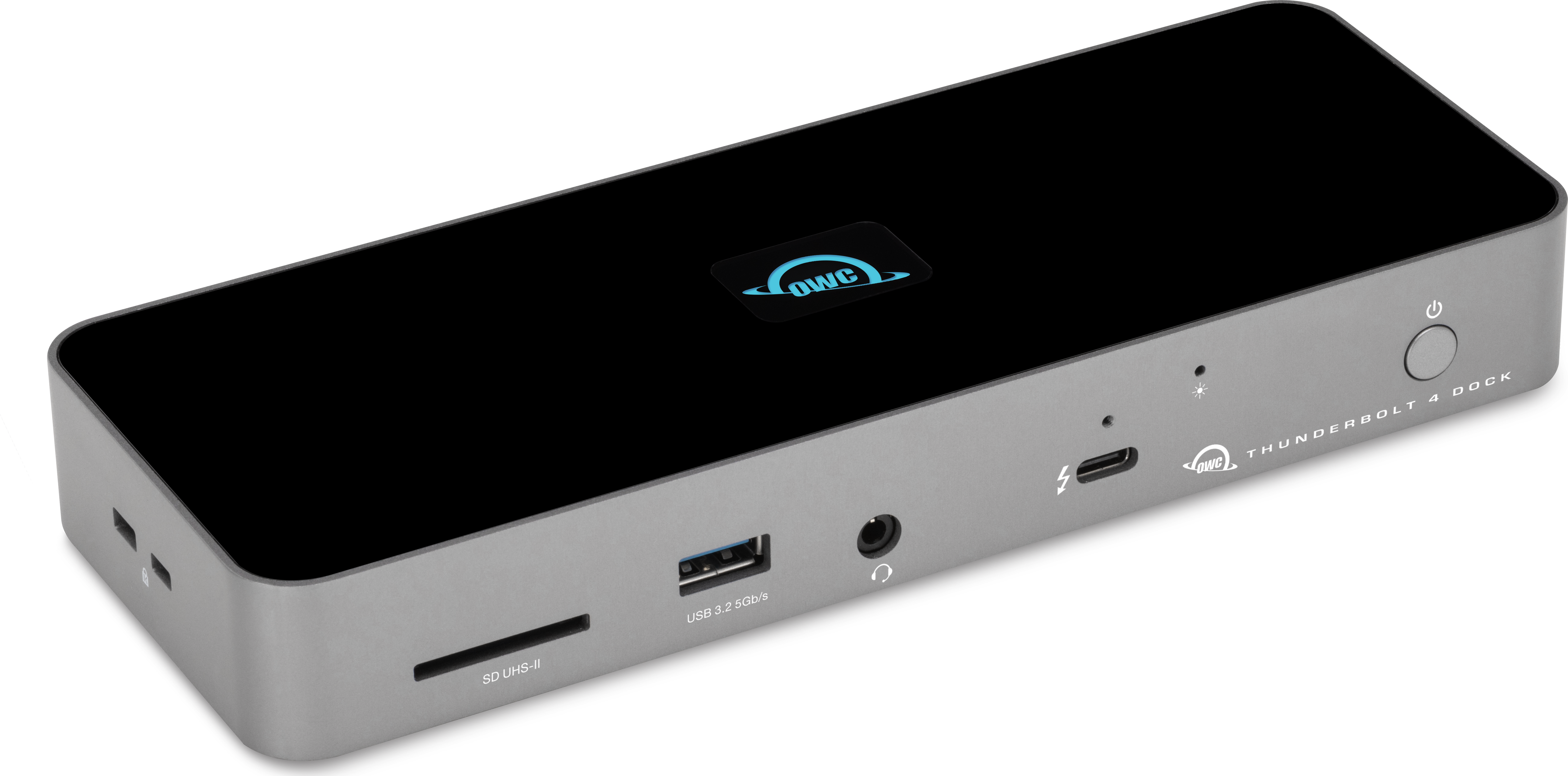
1.3 Front View
A. (1) SD Media Slot – Supports SD 4.0 in UHS-II (Ultra High Speed II) with bus speed up to 156 MB/s (full duplex) or 312 MB/s (half duplex).
B. (1) USB 3.2 Gen 2 (10Gb/s) Type-A Port - Utilize the latest USB devices and accessories.
C. (1) 3.5mm combo Audio in/out Port
D. (1) OWC ClingOn-ready cable stabilizer mount – Affix ClingOn to help prevent accidental cable disconnections (sold separately).
E. (1) Thunderbolt 4 Port - Utilize the latest Thunderbolt devices and accessories. (Up to 15W power delivery).
F. (1) LED Power Switch
- Adjust the Data Connection LED (On | Off) by inserting a pin to press the switch.
- Press and hold for (2) seconds.
- Factory default is On.
G. (1) Device Power Button - Automatically turns on when the power is connected.
- Press the power button to turn off and on the OWC Thunderbolt 4 Dock after connecting the power adapter.

1.4 Rear View
A. (1) DC IN 20V Power Port - Connect external power supply to power the device. (AC Input: 100-240V, 50/60Hz 2.5A | DC Output: 21V/8.58A | Wattage: 140W)
B. (1) 96W Thunderbolt 4 Host Port - Connect included Thunderbolt cable to a compatible system
C. (3) OWC ClingOn-ready cable stabilizer mounts – Affix ClingOn to help prevent accidental cable disconnections (sold separately)
D. (2) Thunderbolt 4 Ports - Utilize the latest USB devices and accessories. (Up to 15W power delivery)
E. (1) RJ45 (1GbE) Ethernet port – Left LED will show Green for 100M/1G connections.
- Right LED will show green for an established link and blink green during network activity.
F. (3) USB 3.2 Gen 2 (10Gb/s) Type-A Ports - Supports USB devices with a Type-A connection.

1.5 Top View
A. Power Status LED
- Solid White = Power Connection
- Solid Blue = Data Connection

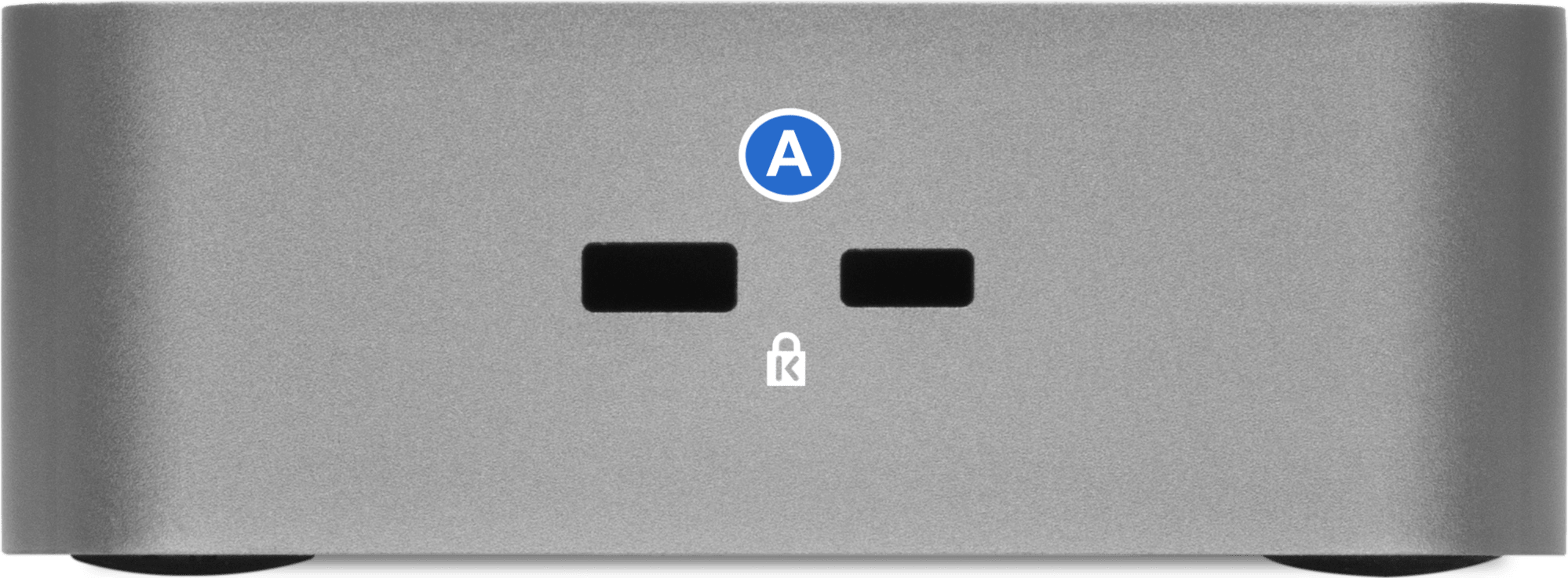
1.6 Side View
A. (1) Kensington Security slot – Attach a Kensington Security lock.
Getting Started
2.1 Device Setup
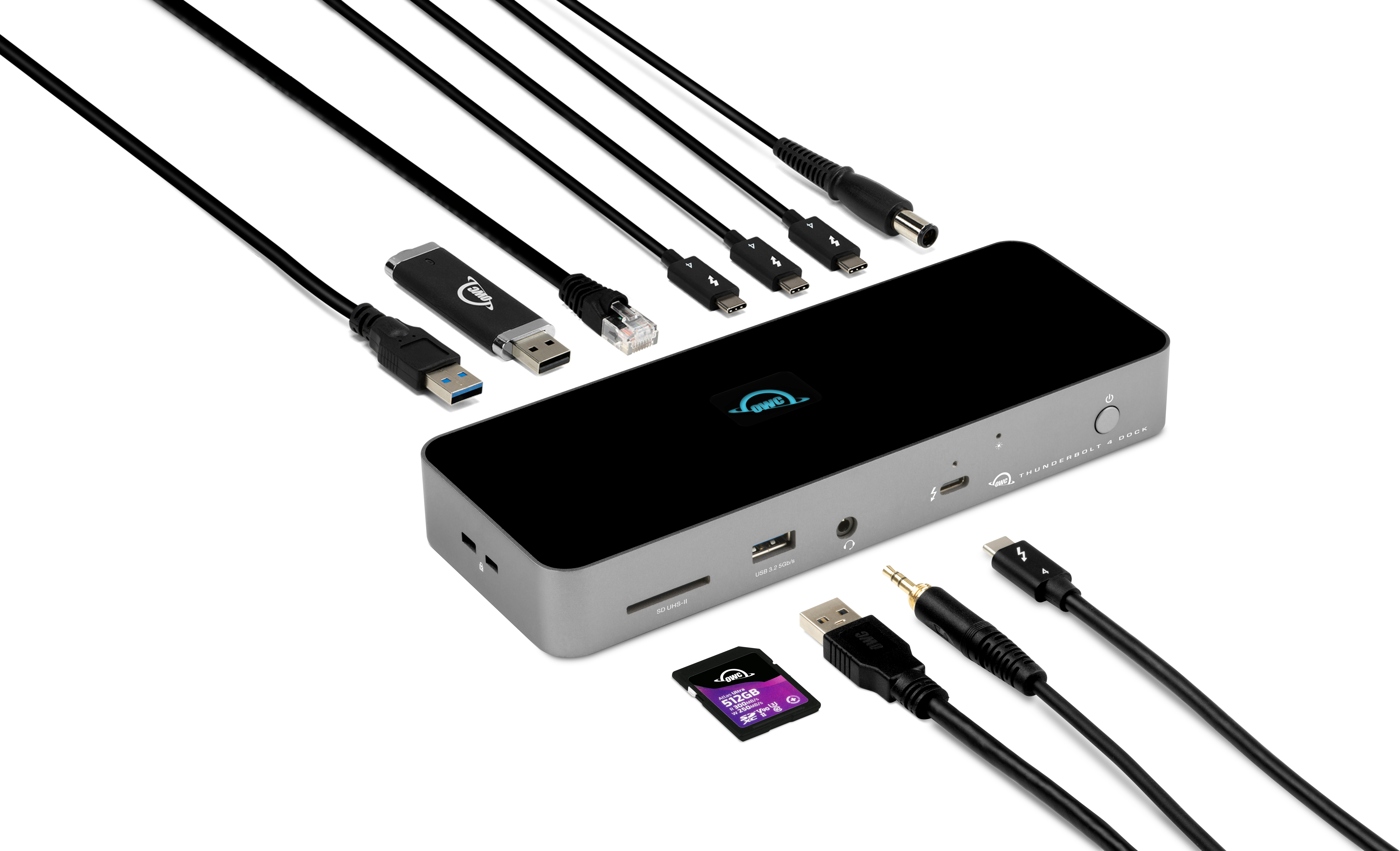
This section describes the process of connecting the OWC Thunderbolt 4 Dock.
1. Plug the power cable into the OWC Thunderbolt 4 Dock DC IN power port located on the back and into a power outlet.
- The Power LED will illuminate a solid white.
2. Connect the included Thunderbolt cable into the Thunderbolt 4 Host Port located in the rear and into a compatible system.
- The Power LED will illuminate a solid blue
3. Download appropriate device drivers.
4. Connect other devices to the appropriate ports on the dock. All connected devices will be available immediately for use on your system.
2.2 Device Drivers
Mac Users
To enable support for the Apple Super Drive, Apple USB Keyboard, and high powered USB charging, please install OWC Dock Ejector for Mac.
PC Users
- Downloading and installing a Realtek driver is required for enabling proper network function.
- Please visit Realtek Driver Support and download the appropriate driver based on the operating system version currently in use. Complete the on-screen instructions provided by the download to complete the driver installation.
- Chipset: Realtek (RTL8156B)
- Please visit Realtek Driver Support and download the appropriate driver based on the operating system version currently in use. Complete the on-screen instructions provided by the download to complete the driver installation.
Device Management
3.1 Unmounting Volumes
To ensure no data is lost during normal use, always eject or unmount the corresponding disk(s) from your operating system before powering off the device. Unmounting options are provided below.
OWC Dock Ejector
- This application safely ejects all volumes connected to the OWC Thunderbolt 4 Dock with a single click, adding peace of mind to fast-paced mobile workflows. To install this app, please follow the steps below.
- NOTE: Enables support for the Apple Super Drive, Apple USB Keyboard, and high powered USB charging.
- Download the installer file for Mac or Windows.
- Launch the installer and complete the prompts. No restart is required.
- An OWC Dock Ejector icon will appear in the macOS menubar, or System Tray on Windows, once the app is running.
- Clicking on the icon will provide options to unmount connected volumes.
- Please review the Support Manual for OWC Dock Ejector for more details.
Manually Unmounting Volumes
macOS
- Drag the icon for the device you wish to unmount to the trash can; OR
- Right-click the device icon on the desktop, then click “Eject”; OR
- Highlight the device on your Desktop and press Command-E.
Windows
- Windows 10 build 1809 (October 2018) or later:
- Eject the drive by clicking the ‘Show hidden items’ menu in the Taskbar, then clicking ‘Safely Remove Hardware and Eject Media’, and last select the ‘Eject’ option for this volume.
- Windows 10 build 1803 and earlier:
- Go to the System Tray (located in the lower right corner of your screen). Click on the “Eject” icon (a small green arrow over a hardware image).
- A message will appear, detailing the devices that the “Eject” icon controls, i.e., “Safely remove...” Click on this prompt.
- You will then see a message that says, “Safe to Remove Hardware.” It is now safe to disconnect the device from the computer.
3.2 OWC Innergize Software
A software application included with OWC Atlas media cards that currently provides three basic functionalities to the user: Health, Sanitize and Field Firmware Upgradability.
- The Health function allows the user to know how much life is left on their OWC Atlas media card
- Sanitize removes ghost data on OWC Atlas media cards which will allow the media cards to perform at their peak and out of factory condition performance in matter of seconds
- Field Firmware upgradability allows OWC to deliver live updates to our memory cards without the hassle of sending them in for an update.
NOTE: Only OWC SDXC memory cards are supported with OWC Innergize software through the OWC Thunderbolt 4 Dock.
Installing OWC Innergize
- Download OWC Innergize application based on the system:
- Open the downloaded file to begin and complete the installation process.
- For additional information regarding OWC Innergize please consult the support manual "OWC Innergize User Guide"
3.3 Usage Notes
Driver Details
- Mac Users: A software driver is required to enable Apple Super Drive, Apple USB Keyboard, and enables high power support for charging and powering USB bus powered devices.
- The driver is included in the OWC Dock Ejector software download package. Please download and install if high powered USB port support is needed.
- Windows Users: Downloading and installing a Realtek driver is required for enabling proper network function.
- Please visit Realtek Driver Support and download the appropriate driver based on the operating system version currently in use. Complete the on-screen instructions provided by the download to complete the driver installation.
Memory Card Details
- SDXC cards inserted into the OWC Thunderbolt 4 Dock will not be recognized by Windows Disk Management or applications after being safely removed.
- Power cycle the entire OWC Thunderbolt 4 Dock by disconnecting the power source. This will allow the OWC Thunderbolt 4 Dock to create a new card session resulting in Windows recognizing the SDXC card.
- Mac Users: The SD Memory Card slot is recognized by the system as "Generic Mass Storage Class Media".
Network Details
- It is not possible to access data on connected drives through the Ethernet interface. The network interface behaves like a network adapter that allows you to connect your computers network via Thunderbolt; it does not allow connected devices to function as Network Attached Storage (NAS).
- Requires 2.5Gb/s Ethernet compatible hardware components and cabling (Cat 5e cable minimum, Cat 6 or later strongly recommended).
- Router and/or Network Switch must support AVB.
Display Details
- Thunderbolt 5 can support up to three displays from a single computer host port dependent on the host computer's capability. This includes up to three 6K or lower resolution displays, three 8K displays @ 60Hz, or two 8K displays @ 120Hz. Display support, including available resolution and refresh rates, is dependent on host hardware and drivers.
- OWC Thunderbolt 4 Dock external display support includes up to three 8K displays @ 60Hz, or two 8K displays @ 120Hz
- Presently, Apple has enabled support for a maximum of two native displays per connected Apple Mac Thunderbolt host port. Software driver based technologies, such as DisplayLink (as supported by the OWC USB-C Dual HDMI 4K Display Adapter), may enable additional display support.
- Please review the Apple silicon External Display Support support article for more details regarding performance how many external displays can be connected to an Apple silicon Mac system.
- Higher refresh rates (above 60Hz) may require DSC (Display Stream Compression) support on the monitor. DSC support is required for 6K and 8K resolutions.
Additional Details
- Thunderbolt 3 Windows systems are not compatible.
- Thunderbolt 2 and earlier systems are not compatible.
- This docking station does not have built-in storage.
- Connected Thunderbolt and USB connected external drive solutions may remain powered on for a short duration of up to 10 minutes when the host system is asleep/powered off or when the dock/hub is physically disconnected from a system. Connected external drive solutions may get warm as they remain powered on. The temperature remains within a normal operation range and has no short or long-term effects on the device, drive, or performance.
- OWC Envoy Pro Elektron and OWC Envoy Pro FX devices remain powered on when the host system is asleep/powered off or when the dock/hub is physically disconnected from a system. These devices may get warm as they remain powered on however, the temperature remains within a normal operation range and has no short or long-term effects on the device, drive, or performance.
- Connected headphones or microphones will need to be manually selected for output/input.
- System Settings > Sound > Output & Input
- Select the connected headphones or microphone to begin use through the OWC Thunderbolt 4 Dock
- System Settings > Sound > Output & Input
Support Resources
4.1 Troubleshooting
- OWC Thunderbolt 4 Dock isn't recognized by the host:
- Verify the OWC Thunderbolt 4 Dock is securely connected to the host.
- Connect the OWC Thunderbolt 4 Dock to a different host port or different host.
- Ethernet connection or performance issues may be resolved by toggling the IPv4 settings between "Using DHCP" and "Manually".
- System Settings > Network > Details > TCP/IP > Configure IPv4
- Change from "Using DHCP" to "Manually". Change back from "Manually" to "Using DHCP".
- System Settings > Network > Details > TCP/IP > Configure IPv4
- Users may experience memory cards not being recognized in OWC Innergize through the OWC Thunderbolt 4 Dock when connecting to a running system.
- Restarting the system while the OWC Thunderbolt 4 Dock is connected will allow OWC Innergize to recognized the connected memory cards.
- Users experiencing slow read/write speeds should consider checking and changing the Windows disk removal policy. Please review the support article Storage Solutions: OWC Disk Performance for more detail.
- We are very sorry If issues continue to occur. Please know that OWC support is here to help. Contact information for our support can be found in section 4.4 "Contacting Support". Please have your serial number ready which is located on the back of the OWC Envoy Ultra and printed on the original packaging.
4.2 Support Resources
Downloads
- OWC Innergize for Mac
- OWC Innergize for PC
- OWC Dock Ejector
- Realtek Driver Support Page (Windows Users)
Product Detail Pages
- OWC Thunderbolt 4 Dock Support Guide Page
- OWC Thunderbolt 4 Dock Product Lander
- OWC Dock Ejector Product Lander
- OWC Innergize Product Lander
Support Manuals
Support Articles
- Storage Solutions: OWC Disk Performance (Windows Users)
- Apple silicon External Display Support (Mac Users)
4.3 Data Backup Notice
To ensure that your files are protected and to prevent data loss, we strongly suggest that you keep two copies of your data on either your internal drive or another storage medium, such as an optical backup, or on another external storage unit. Any data loss or corruption while using the OWC Thunderbolt 4 Dock is the sole responsibility of the user, and under no circumstances may OWC, its parents, partners, affiliates, officers, employees, or agents be held liable for loss of the use of data including compensation of any kind or recovery of the data.
4.4 Contacting Support
4.5 About This Manual
The images and descriptions may vary slightly between this manual and the unit shipped. Functions and features may change depending on the firmware version. The latest product details and warranty information can be found on the product web page. OWC’s Limited Warranty is not transferable and
General Use Precautions
- To avoid damage, do not expose the device to temperatures outside the following ranges:
- Environmental (Operating)
- Temperature (ºF): 41º — 95º
- Temperature (ºC): 5º — 35º
- Environmental (Non-Operating)
- Temperature (ºF): -4º — 140º
- Temperature (ºC): -20º — 60º
- Environmental (Operating)
- Always unplug the device from the electrical outlet if there is a risk of lightning or if it will be unused for an extended period-of-time. Otherwise, there is an increased risk of electrical shock, short-circuiting, or fire.
- Protect your device from excessive exposure to dust during use or storage. Dust can build up inside the device, increasing the risk of electrical shock, short-circuiting, or fire.
- Do not block any ventilation openings on the device. These help to keep the device cool during operation. Blocking the ventilation openings may increase the risk of electrical shock, short-circuiting, or fire.
Safety Precautions
- Use proper anti-static precautions when handling this device. Failure to do so can increase the risk of electrical shock or short-circuiting.
- Never expose your device to rain, or use it near water, or in damp wet conditions. Never place objects containing liquids on the device, as they may spill everywhere and into the openings. This will increase the risk of electrical shock, short-circuiting, fire, or personal injury.
- To avoid any risk of electrical shock, short-circuiting, fire, or dangerous emissions, never insert any metallic object into the device.
- Please cease use of the device and contact OWC Support if it appears to be malfunctioning.
Terms & Conditions of Sale
Warranty
OWC’s products are subject to OWC’s Terms & Conditions of Sale located at Terms of Sale or other applicable terms. The OWC Thunderbolt 4 Dock comes with a 2-Year Limited Warranty. Additional warranty information can be viewed by visiting Hardware Warranties.
Changes
The material in this document is for information purposes only and subject to change without notice. While reasonable efforts have been made in the preparation of this document to assure its accuracy, OWC, its parent, partners, affiliates, officers, employees, and agents assume no liability resulting from errors or omissions in this document, or from the use of the information contained herein. OWC reserves the right to make changes or revisions in the product design or the product manual without reservation and without obligation to notify any person of such revisions and changes.
FCC Statement
Warning! Modifications not authorized by the manufacturer may void the user’s authority to operate this device.
NOTE: This equipment has been tested and found to comply with the limits for a Class B digital device, pursuant to Part 15 of the FCC Rules. These limits are designed to provide reasonable protection against harmful interference in a residential installation. This equipment generates, uses and can radiate radio frequency energy and, if not installed and used in accordance with the instructions, may cause harmful interference to radio communications. However, there is no guarantee that interference will not occur in a particular installation. If this equipment does cause harmful interference with radio or television reception, which can be determined by turning the equipment off and on, the user is encouraged to try to correct the interference by one or more of the following measures:
- Reorient or relocate the receiving antenna.
- Increase the separation between the equipment and receiver.
- Connect the equipment to an outlet on a circuit different from that to which the receiver is connected.
Copyrights and Trademarks
© 2025 Other World Computing, Inc. All rights reserved. OWC and the OWC logo are trademarks of New Concepts Development Corporation, registered in the U.S. and/or other countries. Mac and macOS are trademarks of Apple Inc., registered in the U.S. and other countries. Thunderbolt and the Thunderbolt logo are trademarks of Intel Corporation in the U.S. and/or other countries. Other marks may be the trademark or registered trademark property of their owners.
No part of this publication may be reproduced, stored in a retrieval system, or transmitted in any form or by any means, electronic, mechanical, photocopying, recording or otherwise, without the prior written consent of OWC.
Free Support Chat
Our free award-winning support team is ready to answer all of your questions. Technical support is available Monday - Friday: 9AM - 6PM. Customer Support & Sales is available Monday - Friday: 9AM - 6PM. Support is unavailable on U.S. Federal holidays. Talk to a human today.