RAID Concepts 101
Volume (logical) vs. Disk/Drive (physical)
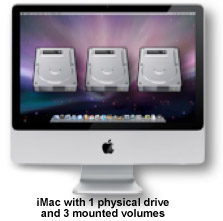
When discussing data storage, it is important to understand the difference between logical and physical.
When someone says,
"I have a 160GB hard drive in my computer." They are referring to the physical disk/drive.
When that same person says,
"There are two drives that show up on my computer." They are referring
to the logical disk/drive, which is referred to as a volume.
When a physical drive is split logically into different volumes, this is called partitioning.
When discussing RAID technology, it is important to be aware of the differences between the logical and physical storage references.
Firmware

Firmware is essentially a small piece of software that resides on a piece of hardware to provide core functionality to the device
as well as interface it with software and other pieces of hardware.
Firmware provides a basic set of operating instructions for the hardware device such as a hard drive.
It helps to think of firmware as a very basic OS (operating system) for a specific piece of hardware.
Drivers

Drivers, like firmware, provide a link from hardware to software.
Drivers reside onthe host OS (Mac OS X, Windows XP, etc.) and give functionality to the hardware present.
For example, your digital camera may require special drivers to be installed on the OS in order for it to transfer photos.
RAID

RAID stands for "
Redundant
Array of
Independent
Disks".
Put simply, this is taking two or more drives and putting them together logically to form a single volume.
This is done for speed, large storage space, redundancy, or any combination of the three.
To accomplish those objectives, the data moving on and off a RAID array is distributed in different variations unique to each objective or combination of objectives.


 1-800-275-4576






