
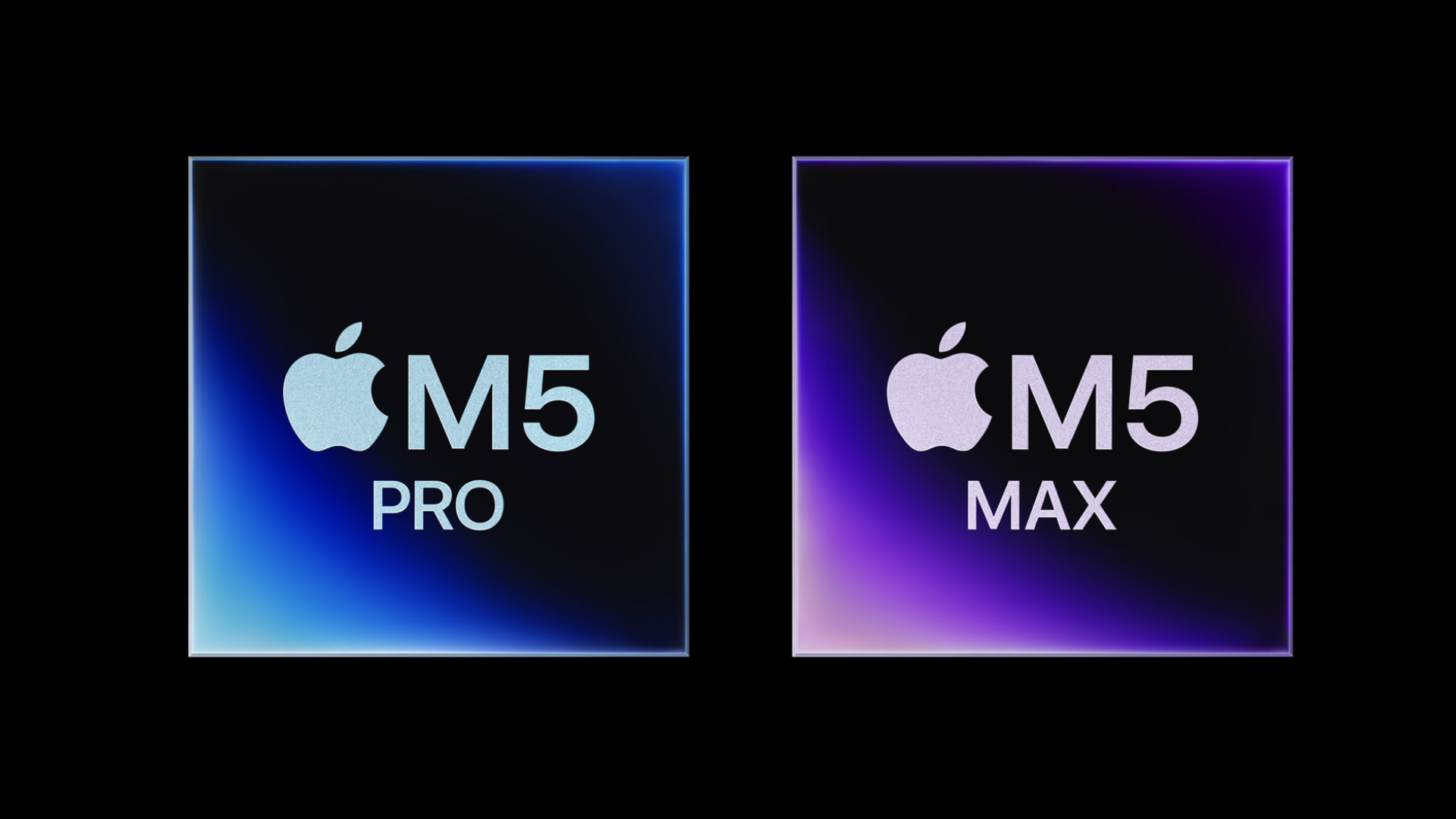
Apple today released not just new products but a new chapter in Apple silicon with the debut of M5 Pro and M5 Max. While the consumer-focused M5 inside both the MacBook Air announced today and in the base model MacBook Pro announced in October of last year uses a conventional single-die design, the Pro and Max M5 variants introduce something Apple is calling Fusion Architecture, a significant engineering departure that connects two dies into a single system on a chip.
This is the most technically interesting Apple silicon announcement in several generations, and it is worth understanding what has changed and why it matters. Let’s dive in.
The New Fusion Architecture: Two Dies, One SoC
M5 Pro and M5 Max are built by connecting two third-generation 3-nanometer dies in a chip package with high bandwidth and low latency. Each die contains a CPU, GPU, Media Engine, unified memory controller, Neural Engine, and Thunderbolt 5 capabilities. By combining them into a single SoC, Apple can scale performance dramatically while maintaining the unified memory architecture and power efficiency that have defined Apple silicon from the beginning.
This approach allowed Apple to deliver a chip with an 18-core CPU and up to 40 GPU cores—roughly double what a single-die design at this process node could practically accommodate—without fragmenting memory into separate pools or introducing the latency penalties of traditional multi-chip designs.
The CPU: What are Super Cores?
M5 Pro and M5 Max feature an 18-core CPU consisting of 6 “super” cores and 12 performance cores. The super core terminology itself is new, but it’s basically Apple’s way of rebranding what used to be called “performance” cores because they represent a significant performance leap from those former performance cores.
As John Gruber helpfully points out at Daring Fireball, there are now three types of cores in M5-series chips: Efficiency, Performance, and Super. Efficiency cores are still around, but only on the base M5 chip where there are six Efficiency cores and 4 Super cores. However, M5 Pro and M5 Max chips no longer contain any “Efficiency” cores. Instead, they contain between 10 and 12 Performance cores, and between 5 and 6 Super cores.
The Super cores are the fastest single-threaded CPU cores Apple has shipped, with improvements in front-end bandwidth, a new cache hierarchy, and enhanced branch prediction.
The Performance cores in M5 Pro and M5 Max are also all-new, and distinct from the Efficiency cores of previous generations of the Pro and Max chips. These new Performance cores are specifically optimized for power-efficient multithreaded work at the pro level. Together with the Super cores, they deliver up to 30 percent faster CPU performance for pro workloads versus M4 Pro, and up to 2.5x the multithreaded throughput of M1 Pro and M1 Max.
The GPU: Neural Accelerators Redefine AI Performance
This is the most consequential change in M5 Pro and M5 Max. The GPU scales from up to 20 cores in M5 Pro to up to 40 cores in M5 Max, and every single GPU core now includes a Neural Accelerator. This architecture was introduced in the base M5 chip but is arriving in the Pro and Max tier for the first time with this generation.
The practical impact on AI compute is enormous. Apple reports over 4x the peak GPU compute for AI tasks compared to M4 Pro and M4 Max, and over 6x compared to M1 Pro and M1 Max. Those figures translate directly to faster LLM inference, AI image generation, on-device model training, and any workload that leverages the GPU for AI acceleration. For developers, AI researchers, and creative professionals increasingly relying on AI-powered tools, this is the most meaningful single improvement in the M5 Pro and M5 Max lineup.
On traditional graphics tasks, the gains are also notable: up to 20 percent higher graphics performance versus M4 Pro and M4 Max, and up to 35 percent better performance for apps using ray tracing (30 percent for M5 Max versus M4 Max). The third-generation ray-tracing engine, second-generation dynamic caching, and hardware-accelerated mesh shading all contribute to real-world improvements in 3D rendering, VFX compositing, and gaming.
Memory: More Capacity, Much Higher Bandwidth
M5 Pro supports up to 64GB of unified memory at 307GB/s of bandwidth. M5 Max doubles that to 128GB at 614GB/s. These bandwidth figures represent major increases over the previous generation and are central to the AI performance story. Higher bandwidth means the GPU and Neural Engine can feed more data to AI models per unit of time, directly accelerating inference and generation speeds.
For users running large language models locally, the memory capacity ceiling matters as much as the bandwidth. 128GB of unified memory on M5 Max means larger models can run entirely in-context without being paged to storage, which improves both speed and response quality.
Two Industry Firsts Worth Noting
Memory Integrity Enforcement is also new in M5 Pro and M5 Max. Apple describes it as an industry-first, always-on memory safety protection that does not compromise device performance. For professionals handling sensitive data, this is a meaningful security baseline improvement that previous chips did not offer.
The Thunderbolt 5 implementation in M5 Pro and M5 Max is also worth highlighting. Each Thunderbolt 5 port is supported by its own dedicated, custom-designed controller built directly into the chip—no external controller required. Apple says this makes it the most capable Thunderbolt 5 implementation in the industry, with improvements in external storage throughput, display bandwidth, and daisy-chain reliability.
M5 Pro vs. M5 Max: Who Needs Which
M5 Pro is aimed at demanding professional workflows that need serious CPU and GPU performance with substantial memory headroom: software developers, photographers processing large libraries, audio engineers, data scientists, and the majority of video editing professionals. Up to 64GB of unified memory and 307GB/s of bandwidth comfortably handle the vast majority of professional workloads.
M5 Max is for users whose work is limited by GPU throughput and memory bandwidth: 3D animators rendering complex scenes in Cinema 4D or Houdini, VFX artists compositing high-resolution footage in Nuke or Autodesk Flame, AI researchers training and fine-tuning custom models, and engineers running large-scale simulations in MATLAB or similar tools. The 40-core GPU and 614GB/s bandwidth put M5 Max in a category by itself for a portable machine.