

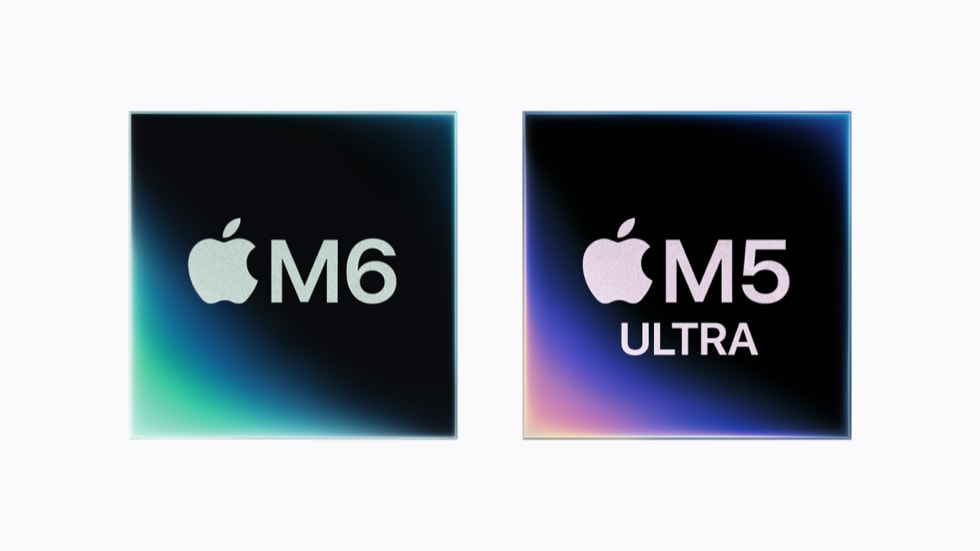
Apple today capped off one generation of Apple Silicon while launching another. And both new chips are important in their own way. The new M6 represents a leap forward in chip architecture while the new M5 Ultra is the most powerful chip the company has produced to date.
Let’s take a deeper look at the purpose behind these chips and the performance gains you can expect to see.
M6: Small Chip, Big Jump
The M6 is a big deal because it’s the very first 2-nanometer (nm) chip to hit the market. Without getting too technical, as we have gone from 5nm chips to 3nm chips and now to 2nm, what that translates to is Apple’s ability to pack more transistors onto a chip. That translates to faster speeds with less heat being generated for improved sustained performance.
The M6 packs a 12-core CPU — two cores more than M5 — split into 2 “super cores,” 4 performance cores, and 6 efficiency cores. An additional two cores on a base model chip is a big deal and Apple says the super cores in particular deliver the fastest single-threaded performance of any CPU core on the market. Meanwhile, multithreaded gains reach up to 1.2x over M5 and 2.4x over the original M1. In other words, if you’re still holding on to an M1- or even M2-generation Mac, you will see performance improvements with M6 that will be very, very noticeable.
M6’s new 12-core GPU adds a Neural Accelerator to every core, boosting peak AI compute by nearly 30 percent over M5 and more than 8x over M1. These gains translate to noticeably snappier on-device LLM prompt processing. On the gaming/graphics side, M6 brings Dynamic Caching, hardware-accelerated ray tracing, and a 50 percent bump in geometry rates.
Rounding things out, M6 introduces a Dual 16-core Neural Engine that doubles peak AI compute versus M5, with system frameworks able to tap both engines at once for faster model execution.
Like the M5, M6 unified memory support tops out at 32GB though bandwidth has climbed 10 percent to 170GB/s.
M5 Ultra: Beastly New Quad-Die Architecture
Apple introduced its Fusion Architecture technology earlier this year with the launch of the M5 Pro and M5 Max chips. On those chips, the process fuses together two third-generation 3-nanometer dies into single a chip package with high bandwidth and low latency. The reason that’s important context is that it laid the groundwork for what Apple just announced for M5 Ultra.
Ultra chips have always been two chips fused together using a process Apple calls UltraFusion. So, when Apple launched the M5 Pro and M5 Max chips as single chips formed by fusing multiple dies, it was reasonable to assume that the next Ultra chips would then fuse two of those double-die chips together as well to create an absolute behemoth of a chip.
And that’s exactly what happened with M5 Ultra. If you’re following our math, that makes M5 Ultra the first Apple chip to fuse four dies together using an upgraded generation of of UltraFusion. We used to get excited about quad core processors. Now Apple is producing quad-die processors. And if you’re going to fuse four dies together, you’ve got to be able to support a lot of bandwidth. UltraFusion’s inter-die bandwidth now exceeds 4.4TB/s, with connection density up more than 6x, letting the four dies act as one unified chip rather than a cluster of separate parts.
The resulting spec sheet is staggering: up to a 36-core CPU (12 super cores plus 24 performance cores) delivering up to 1.25x faster single-threaded and 1.3x faster multithreaded performance than M3 Ultra, alongside an up-to-80-core GPU that Apple says offers 4.5x the peak AI compute of M3 Ultra and more than 6x that of the original M1 Ultra. Every one of those GPU cores includes a Neural Accelerator, and the chip pairs all of that with a 32-core Neural Engine for on-device AI tasks.
Then there’s memory. M5 Ultra supports up to 512GB of unified memory with an absolutely massive 1.2TB/s of bandwidth. That’s 50 percent higher than M3 Ultra and enough, Apple says, to keep enormous datasets and LLMs with hundreds of billions of parameters entirely in local memory, no cloud round-trip required. As we covered in our primer to running local AI models on a Mac, these M5 Ultra numbers represent the ability to run multiple extremely capable local models.
Raising the Roof—and the Floor
These chips represent major advances at both the entry-level end of the Mac lineup and at the high-end. The M6 launches inside the new Mac mini while the M5 Ultra is available in the latest Mac Studio. You can read more about the new Mac mini here and more about the new Mac Studio here.